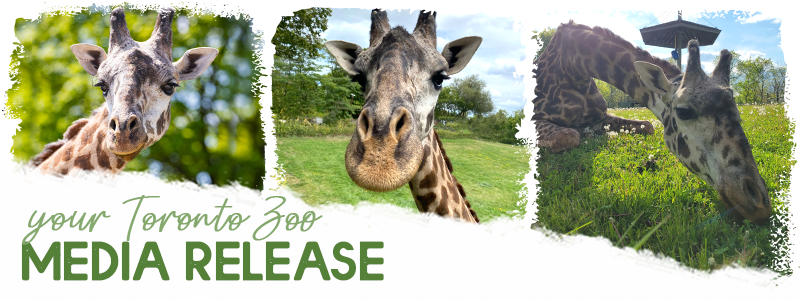
Grieving the Loss of “Kiko”, the Masai Giraffe
Toronto ON, Friday, January 2, 2026: 2026 has begun in the most heartbreaking way with the sudden and tragic loss of Kiko, a beloved 13-year-old male Masai giraffe. On the afternoon of Thursday, January 1, 2026, Kiko was given access to an additional area of his behind-the-scenes habitat. True to his curious nature, he began exploring the space and tragically became caught in an opening door. Masai giraffes have relatively delicate heads supported by a six-foot neck capable of moving forward, backward, up, down, and side to side, allowing their head position to shift quickly. Despite the team’s immediate response, Kiko panicked and sustained injuries that, due to the unique anatomy of his species, proved fatal. This loss is impacting Kiko’s Wildlife Care team particularly hard, as shifting giraffes is a normal routine they have done thousands of times without incident. Over the last few months, our Wildlife Health and Care team have also been providing Kiko with specialized care behind-the-scenes in the giraffe house to treat a hoof/foot injury, which meant tailoring his habitat and daily routine to give him the best chance for a full recovery.
Kiko has been sent to the University of Guelph for a full postmortem, and a thorough investigation has been initiated by the Zoo’s Health and Safety Services team. While this appears to be a very tragic and unfortunate incident, as an accredited zoo, we will share the findings once the full investigation has concluded. We are committed to learning from this tragedy and sharing any findings with our broader community, and we are determined to learn from this tragedy to prevent anything like it from occurring again.
Masai giraffes in the wild are under severe pressure, which makes the loss of one individual in human care especially heartbreaking. Not long ago, Masai giraffes were the most common type of giraffe, today their numbers have dropped to just over 43,000. In 2018, the Masai giraffe was listed as Endangered by the International Union for Conservation of Nature (IUCN) after their population declined by nearly 50% over 30 years. Masai giraffes continue to face serious threats from poaching and the loss of their natural habitat.
Because of this, accredited zoos play a critical role in their conservation. Zoos provide well-managed environments where giraffes can thrive, help maintain healthy populations through coordinated breeding programs, support conservation research, and raise public awareness about the challenges giraffes face in the wild. While the challenges remain, recent updates show their numbers have begun a slow but steady recovery over the past five years, thanks to conservation efforts both in the wild and under human care.
Kiko came to our Zoo from Greenville Zoo in South Carolina, where he was born in 2012. Your Toronto Zoo is part of the Association of Zoos and Aquariums (AZA) Masai Giraffe Species Survival Plan® (SSP), a cooperative breeding program among accredited zoos that recommended the pairing of female giraffe Mstari and Kiko. Kiko has been an important ambassador animal for his species, and his legacy lives on as he contributed to the Species Survival Plan® by siring two calves, with a third due in early 2026.
While we mourn this significant loss, we are focused on supporting our team as well as Mstari as she is in the later stages of her pregnancy. We ask that you please keep our staff and volunteers in your thoughts during this incredibly difficult time and join us in remembering and honouring Kiko – a magnificent giraffe who touched so many hearts.