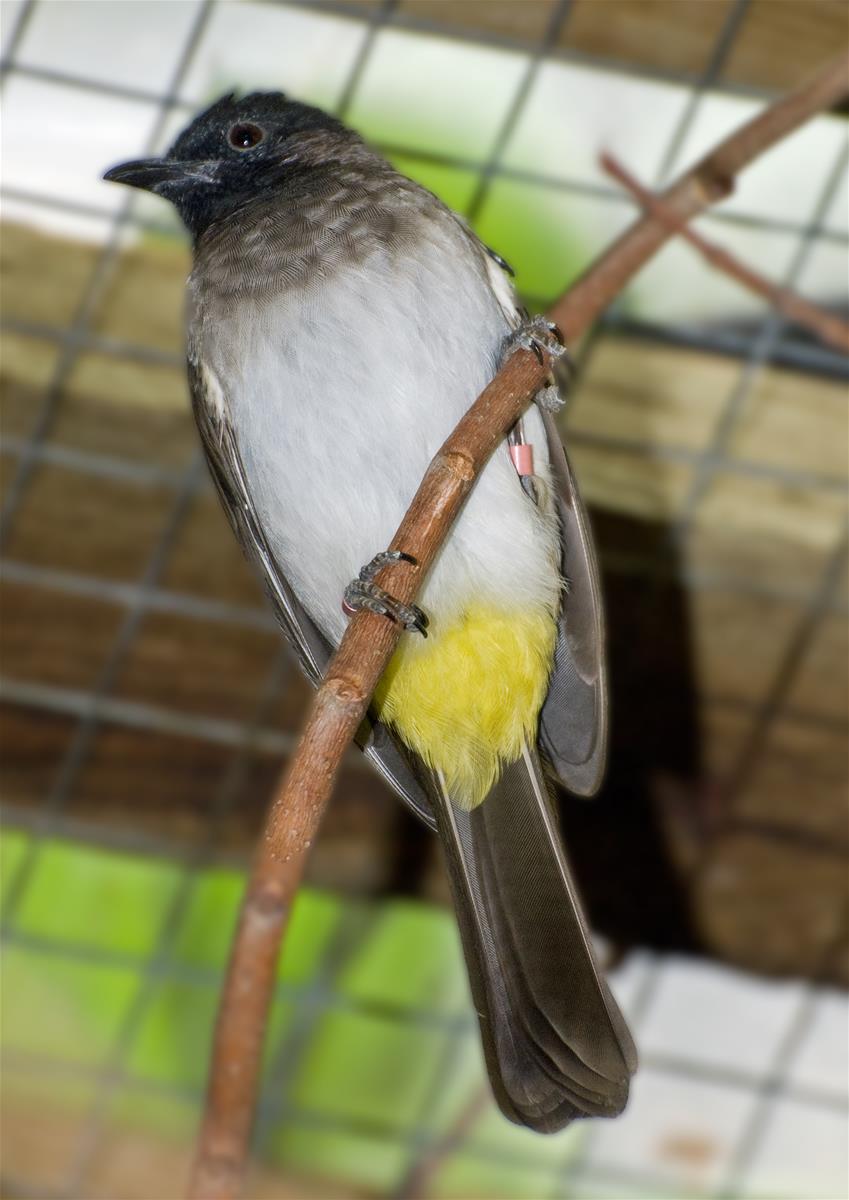
Yellow-vented bulbul
Pycnonotus barbatus
Order: Passeriformes
Family: Pycnonotidae
Genus: Pycnonotus
This bulbul can measure up to 18 cm in length, and weigh up to 60 g. It is a mostly grey/brown bird with a paler white/brown belly and a bright yellow vent. It sports a slight dark pointy crest on top of its head. Its bill, eyes and feet are black, and it has a dark eye-ring, although difficult to see on the dark feathers of the head. These slim birds have long tails. Male and female have the same plumage and the juveniles are similar, but a little duller in colour with more brown/grey on the throat area. Females are slightly smaller than the males. Their flight is bouncy.
Distribution
This family of songbirds is widespread over Asia and Africa. Pycnonotus barbatus is found almost everywhere in Africa.
Habitat
These birds are very versatile and thrive in many different habitats, ranging from tropical and subtropical woodland, coastal bush, montane scrub, deserts and savanna, to farming habitats, garden,s and parks. They live easily alongside humans.
Diet
Bulbuls are omnivores. They will eat fruits, both wild and cultivated and also nectar, insects, and even small lizards.
Reproduction
These birds are monogamous and appear to pair for life. They perform rituals of preening and singing together. Between September and December, the pair builds a rigid cup-shaped nest in a shrub or tree, and the female will lay between two and five eggs. During the incubation period of 12 to 14 days, it is mainly the female who sits on the nest, but after hatching, both adults will take care of the young. There are two broods per season.
Adaptations
These birds are usually seen in pairs or small groups. They are active and noisy and very adaptable, happy to live alongside humans and take advantage of food available in gardens and farms.
Threats to Survival
This common to abundant species is not at risk. It has large range and in those ranges, populations seem to be increasing. Bulbuls are useful to humans as seed dispersers and insect eaters.