Viewable

Bird
Location at the Zoo
African Rainforest
Global Range
Africa
Violaceous plantain eater
Musophaga violacea
Order: Musophagiformes
Family: Musophagidae
Genus: Musophaga
Like all 23 species of turaco, the violaceous plantain-eater (also known as the violet turaco) has an eye-catching head. However, it's the only turaco lacking a crest. Instead, it has a yellow frontal shield which extends to the high point of the head. From there, the crown and nape are a deep crimson, their fine hairlike feathers resembling a brush cut. The bill is deep orange with oval nostrils. To complete the head's vivid coloration, the bare eye ring is orange-red, and is wider on the bottom. It surrounds a brown iris. To finish off the face, a white line shaped like an eyebrow extends from the bottom of the eye ring to the ear coverts.
The uppers, including cheeks, throat and tail, are a deep metallic bluish violet. In sharp contrast to this somberness, the outer secondaries and all primaries flash a brilliant red, above and below, when the violaceous plantain-eater takes flight. When perched, the red may appear as a small wing patch. The primary coverts and tips of the primaries are brownish black. The underparts are black glossed with blues and greens.
The tail is long and broad. Legs are relatively short and grey-black in colour. Claws are short and abruptly curved. Toes are semi-zygodactylous.
Length: 48 cm.
Wingspan: 21 cm.
Bill: 4 cm.
Weight: 360 g.
The uppers, including cheeks, throat and tail, are a deep metallic bluish violet. In sharp contrast to this somberness, the outer secondaries and all primaries flash a brilliant red, above and below, when the violaceous plantain-eater takes flight. When perched, the red may appear as a small wing patch. The primary coverts and tips of the primaries are brownish black. The underparts are black glossed with blues and greens.
The tail is long and broad. Legs are relatively short and grey-black in colour. Claws are short and abruptly curved. Toes are semi-zygodactylous.
Length: 48 cm.
Wingspan: 21 cm.
Bill: 4 cm.
Weight: 360 g.
Conservation Status: IUCN
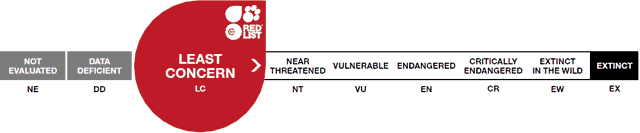
Distribution
Gambia, southern Senegal, southern Mali, southwest Burkina Faso, southwest Niger, Guinea-Bissau, Guinea, Côte d'Ivoire, Ghana, Togo, Benin, northern Nigeria and northwest Cameroon. A small, isolated population exists at about 20° E. on the border between Chad and the Central African Republic.Habitat
Found around dry savannas in forest margins, gallery woodlands, and tree stands along rivers. They avoid humid forests. In urban areas, they frequent tall trees of parks and gardens. They have been seen up to 1350 m.Diet
Prefers figs, but eats other fruits, berries, seeds and insects for protein.Reproduction
Mating is generally timed to the coming of the rainy season. Chasing by the male marks the onset of courtship; ritualized feeding from male to female follows. A flimsy, fragile nest of sticks lined with twigs houses two eggs about six metres off the ground. Incubation, by both sexes, lasts about 23 days. Hatchlings are covered in a thick grey down. Brooding, feeding and removal of fecal sacs are done by both parents. The young are fed regurgitated fruit. By day 18, they have fledged and are eager to clamber around nearby branches. Around day 30, they're ready to fly.Adaptations
Bright colours in birds are usually produced by refraction. Almost alone among animals, some turacos are able to store copper pigments in their bodies. The violaceous plantain-eater has only the red one, turacin, in large amounts. Because it has to eat a lot of plant material to get sufficient turacin, it takes from three to five months before it reaches its full adult coloration. Facial patterns are important in breeding as it is one way that this species recognizes the opposite sex.Violaceous plantain-eaters are birds of the forest treetops. Even with bright heads, they blend in with the foliage. However, being social birds, they gather to eat and their noise gives them away. They will also spend time sunbathing and preening. Towards dusk, they again gather noisily in the canopy near their roosting spots.
Like all turacos, Musophaga violacea is an important disperser of seeds. When flying in search of fruit, rounded wings and a long, widespread tail give the violaceous plantain-eater great agility to maneuver through the dense treetops. Its flight is characterized by irregular, flapping wing beats interspersed with gliding. To cross an open space, they fly single file. With its long, thin body, the violaceous plantain-eater can pursue fruit by bounding adeptly through the branches and foliage or by running crouched with squirrellike nimbleness along the limbs.
Zygodactylous toes have the first and last toes pointing backwards while the middle two point forward. Semizygodactylous toes, the ability to reposition the outer toe, give the violaceous plantain-eater greater adaptability. For greater thrust when running, it will move its outer toe forwards. For a stronger grip when perching, it will leave that toe in its normal back-facing position. When just sitting, that same toe may be at a right angle.
Violaceous plantain-eaters can start a new clutch as soon as 35 days after the previous brood hatched. The juveniles often help out with this next generation. They assist with incubation (sitting with the mother), and attend to the hatchlings, but won't usually feed them until they've fledged. When the newborns attempt to fly, the juveniles sometimes accompany them and will guide them back to the nest. At the same time, juveniles learn the territoriality of the species from their mother, often assisting her in chasing off intruders.
A croaking cou-cou---rhou is their call. When repeated asynchronously in a series with another violaceous plantain-eater, it has been described as a "pulsing roar".