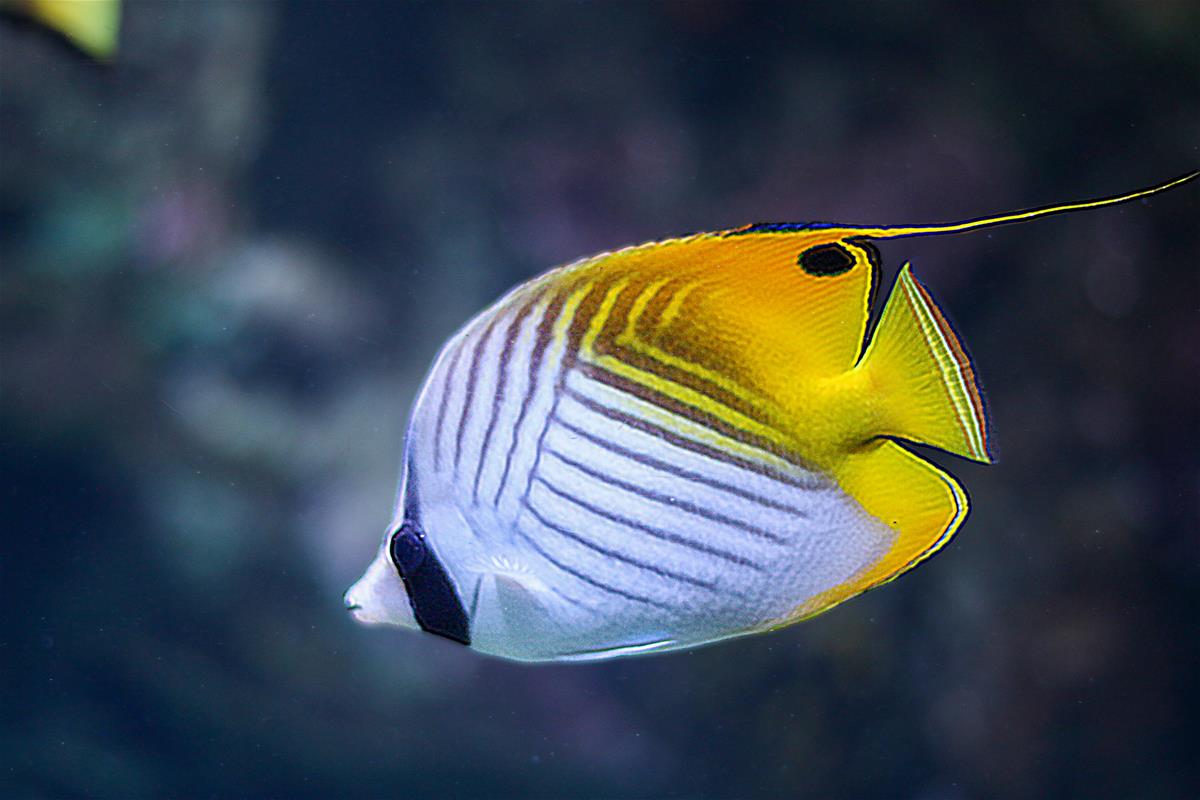
Threadfin butterflyfish
Chaetodon auriga
Order: Perciformes
Family: Chaetodontidae
Genus: Chaetodon
This fish is oval in shape, growing 20 - 23 cm in length. It has a long pointed snout with sharp, narrow teeth. Its head and the front portion of its body are white, while the rear of the body, the tail and rear parts of the dorsal and anal fins are yellow. There are black lines on the white body and a large black bar from the eye downwards. There is a black eyespot on the rear dorsal fin and a long, black, thread-like filament that trails from the dorsal fin of the adult fish of this species - the young do not have this filament, but it does increase in size as the fish grows. Males and females have the same coloration.
Distribution
These are marine species, found throughout the tropical Indo-Pacific Ocean.
Habitat
C. Auriga is found in areas where there are coral or rocky reefs at depths of 1 - 30 m.
Diet
C. Aurgia are omnivores and feed from the coral and rocky reefs. Their diet consists of hard and soft corals, microalgae, worms, molluscs, sponges, and plankton. They are hunters, using their sight to locate their prey.
Reproduction
Butterflyfish are monogamous, and breed frequently throughout the year. They will keep the same mates for a lifetime, although they will find a new mate if one dies. The females release hundreds of thousands of eggs into the water, where they are externally fertilized. Once the eggs are fertilized, there is no more parental involvement. Embryos hatch in about 30 days and spend another 40 days as plankton floating in the water before they morph into juvenile fish.
Adaptations
Their long, narrow snouts allow them to access food in the cracks and crevices of the coral reefs they inhabit. The eyespot on their dorsal fin and the long filament that trails from the fin confuse predators. With these adaptations, predators are more likely to attack the rear of the fish and give it a chance to escape. The dark bar across their eyes likely helps in this confusion. They have spiny fins which serve as protection, and they are quick swimmers.
Threats to Survival
At this time, C. Auriga is common, and there is no threat to their populations. However, they depend on coral reefs for their habitat and food. If the coral reefs are damaged, then populations of C. Auriga would be adversely affected.