Viewable
Location at the Zoo
African Rainforest
Global Range
Africa
Spider Tortoise
Pyxis arachnoides
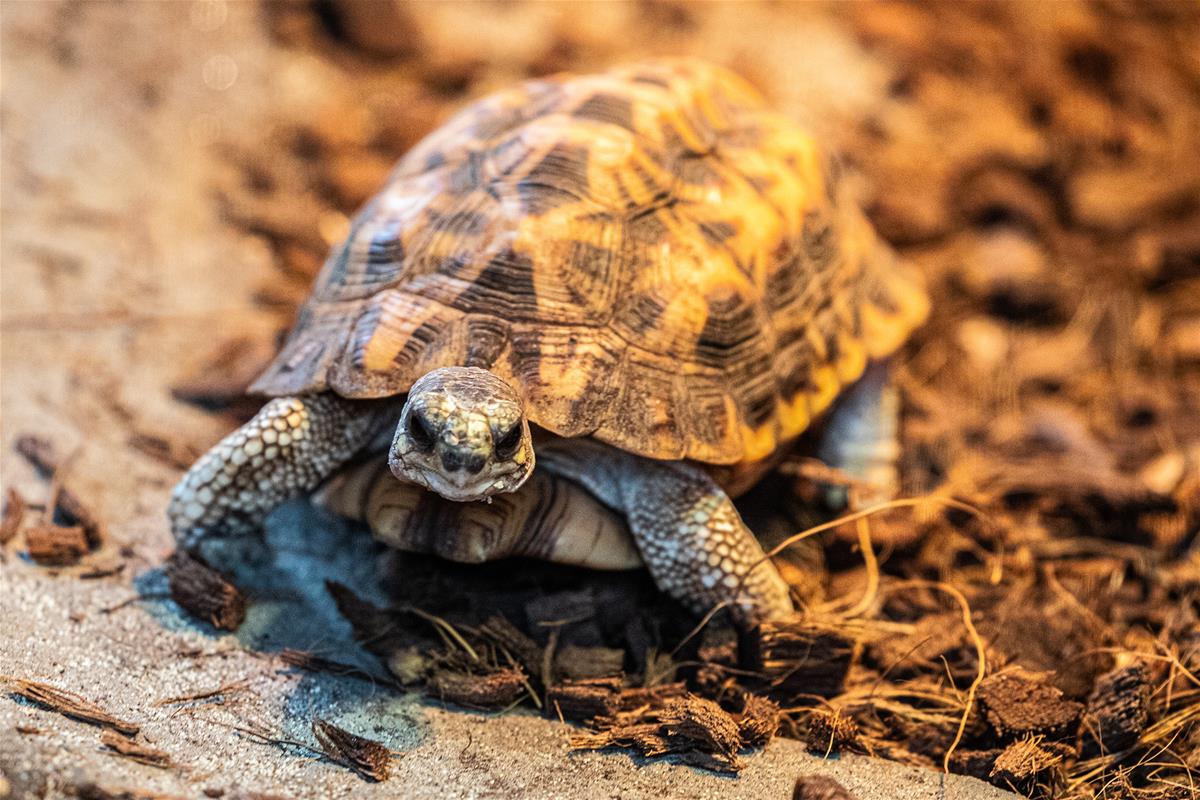
The Spider Tortoise is a small but striking tortoise named for the intricate, web-like pattern on its shell, which resembles a spider’s web radiating outward from each scute. Adults typically measure 12 to 15 centimetres in shell length and weigh less than one kilogram. The shell is high-domed and patterned in yellow and dark brown or black, while the limbs and head are relatively pale with fine scaling.
Despite its modest size, this species is long-lived and slow-growing. It is generally shy and spends much of its time hidden beneath vegetation or leaf litter. In zoological settings, the Spider Tortoise often draws attention for its delicate appearance and its close relationship to the better-known Radiated Tortoise, while also illustrating how even small reptiles can face significant conservation challenges.
HEAD AND BODY LENGTH
Shell length typically ranges from 12–15 centimetres.
WEIGHT
Usually under 1 kilogram.
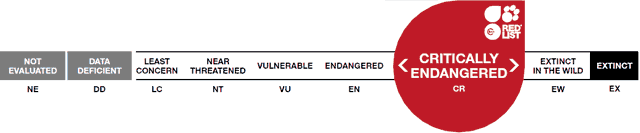
Conservation Status: IUCN
Distribution
Restricted to a narrow band of southern and southwestern Madagascar, primarily near coastal regions. The species’ range is fragmented, with populations isolated from one another.
Habitat
Inhabits dry spiny forest, coastal scrub, and thorny woodland, often in sandy soils with low, dense vegetation. It shelters under shrubs and leaf litter to avoid heat and predators and is most active during cooler parts of the day.
Diet
Herbivorous. Feeds on grasses, leaves, flowers, fallen fruit, and other low-growing vegetation. Its diet reflects the seasonal availability of plant material in arid environments.
Reproduction
Breeding occurs seasonally. Females typically lay one egg at a time, occasionally two, in shallow nests dug into sandy soil. Incubation lasts several months, and hatchlings are highly vulnerable to predation. The species’ low reproductive output contributes to its sensitivity to population loss.
Adaptations
The spider-like shell pattern may help break up the outline of the shell in dappled light and vegetation. A small body size reduces energy needs in dry habitats. Thick, scaly limbs and a domed shell provide protection, while behavioural adaptations such as remaining hidden during the hottest parts of the day help reduce water loss.
Threats to Survival
Major threats include illegal collection for the pet trade, habitat destruction, and loss of traditional protections. Climate change may further stress populations by altering rainfall patterns and vegetation structure. Because of its extremely limited range and slow reproduction, even small increases in mortality can have severe population impacts.