Viewable
Reptile
Location at the Zoo
Australasia
Global Range
Australasia
Solomon Island monkey-tailed skink
Corucia zebrata
Order: Squamata
Family: Scincidae
Genus: Corucia
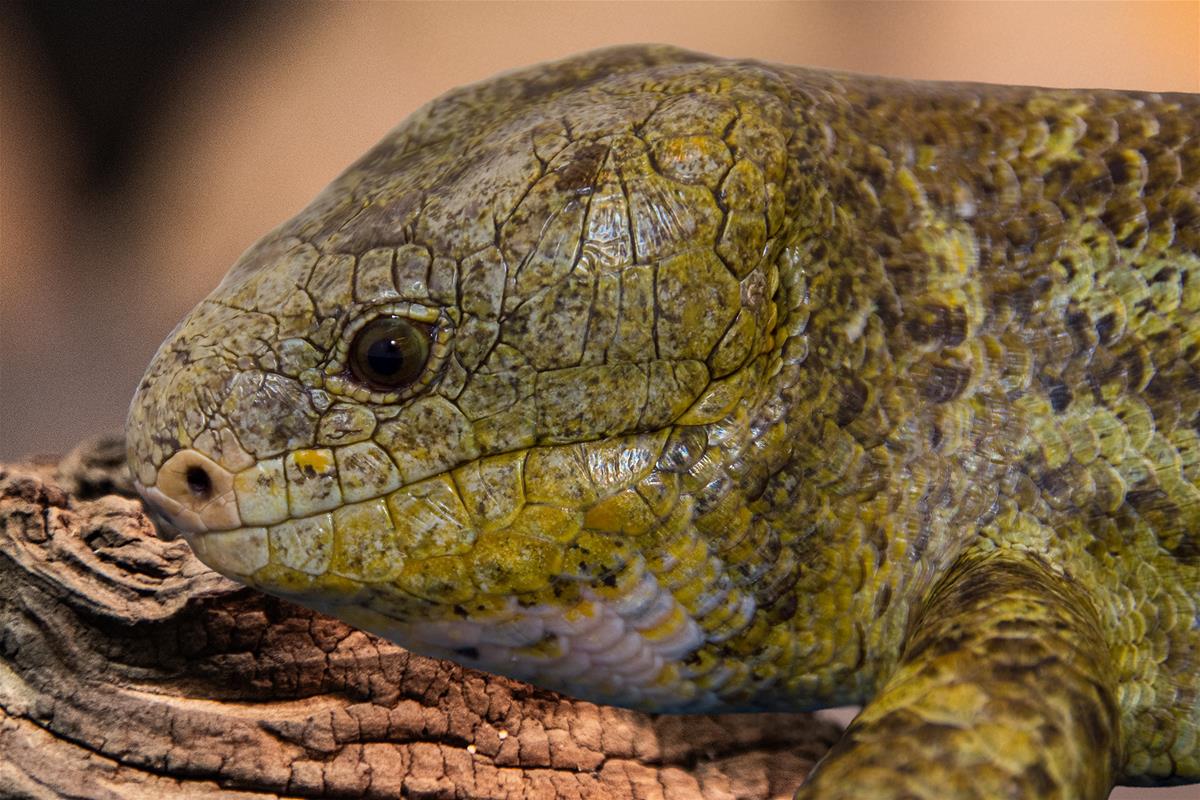
This is the largest of the known living skinks. It has a long, slender body. The head is flat and triangular with small round eyes. Sexual dimorphism occurs with the male skink having a broader head and a more slender body shape than the female. It has thick, strong, short legs. The toes on all four legs have thick, curved nails. The tail is prehensile and is longer than the body.
It has strong jaws with small teeth. The skin of this skink is smoother and shinier than others. The smooth, flat, overlapping scales are dark green in colour, often speckled with light brown or black. On the underside they vary from light yellow to different shades of green. Fully grown, they can reach up to 72 cm.
It has strong jaws with small teeth. The skin of this skink is smoother and shinier than others. The smooth, flat, overlapping scales are dark green in colour, often speckled with light brown or black. On the underside they vary from light yellow to different shades of green. Fully grown, they can reach up to 72 cm.
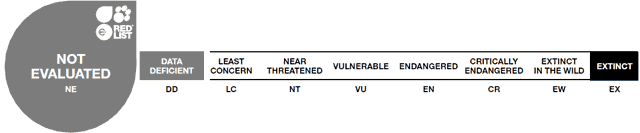
Conservation Status: IUCN
Distribution
This skink is endemic to the Solomon Islands, a group of islands in the south-west Pacific Ocean. Sub-species are found on neighbouring islands.Habitat
Being strictly arboreal, this skink usually inhabits the upper canopy of forested areas throughout its range. It is commonly found in strangler fig trees (Ficus sp.) if they have epiphytic growth of the food plants the skink consumes. It also occurs in trees in semi-cleared areas and cultivated food gardens.Diet
It is herbivorous, feeding on leaves, flowers, fruits and growing shoots of several different species of plants including epiphytes. Juvenile skinks often eat feces from adults to acquire the necessary microflora to digest their food.Reproduction
Skinks are very territorial and live in a family or communal group referred to as a circulus. Copulation occurs during early evening in the trees and may last from 5 to 15 minutes. They reproduce by viviparous matrotrophy. The female produces eggs that develop within her body and are nurtured there by placental connection to her. She gives birth to live young after a gestation period of six to eight months. Most births are single babies but occasionally twins are born. Newborns weigh about 175 grams and are usually 37 cm long which is a large size compared to the mother. The newborn skink will stay within its circulus for 6 to 12 months with its parents and unrelated adults protecting it. Females can exhibit fierce protective behaviour around a newborn. Usually, at around one year of age, the young skink will leave its group to form a new family group. Sexual maturity is reached at two years of age.Adaptations
They are one of the few species of reptile known to function within a social group. The male and female are both territorial and often hostile towards other skinks that are not part of their family group. Both will defend their baby, a very unusual behaviour for a reptile. Adult female skinks will “adopt” orphaned young skinks ensuring their survival.They are crepuscular and nocturnal and retreat to the high canopy rainforest during the day. Primarily active at night it uses its sense of smell to identify its territory and other members of its group. Similar to snakes, they smell by flicking their tongue to gather scents and on retraction, touch the tongue to the opening of a Jacobson’s organ on the mouth roof.
Unlike some lizards, it does not have the ability to regenerate its tail, should it break off. However, their tails are prehensile, meaning they can curl them around objects such as branches and hold onto them for balance. Its prehensile tail helps it to maneuver from branch to branch. The sharp claws help to grip and climb tree limbs. Cryptic colouration provides excellent camouflage from enemies.