Viewable
Location at the Zoo
Australasia
Global Range
Australasia
Red-bellied Short-necked Turtle
Emydura subglobosa
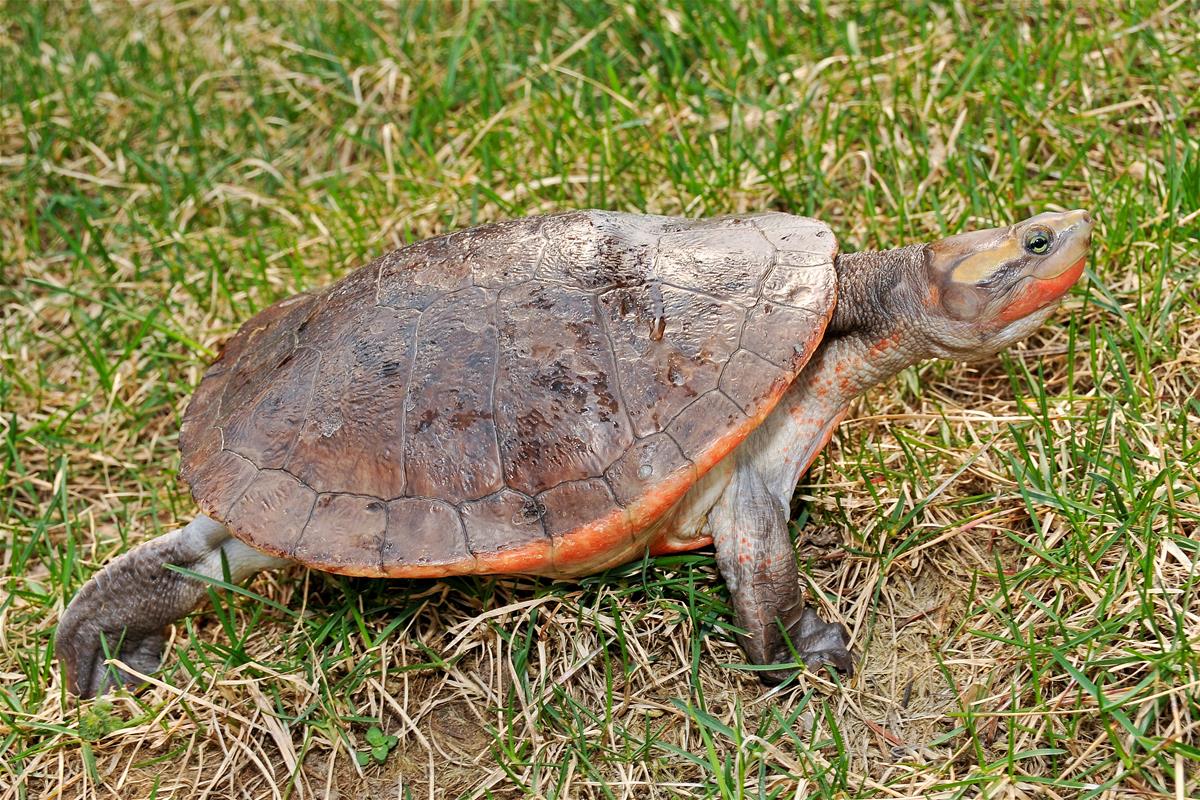
The Red-bellied Short-necked Turtle is a small to medium-sized freshwater turtle best known for the bright red or orange colouring on the underside of its shell, a feature that gives the species its common name. Adults typically reach 20 to 25 centimetres in shell length. The upper shell is smooth and rounded, coloured olive to dark brown, while the head and limbs are grey to brown with faint yellow striping.
Unlike long-necked turtles, this species has a relatively short neck that retracts straight back into the shell. It is an active swimmer and often seen basking on logs or rocks near the water’s edge. In zoo settings, the vivid red plastron is often highlighted as an example of how colouration can vary dramatically between the upper and lower surfaces of turtles.
HEAD AND BODY LENGTH
Shell length usually ranges from 20 to 25 centimetres.
WEIGHT
Adults generally weigh between 1.5 and 3 kilograms, depending on age and sex.
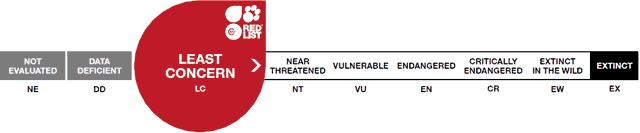
Conservation Status: IUCN
Distribution
Found in northern Queensland and across parts of southern Papua New Guinea, primarily within lowland river systems and wetlands.
Habitat
Inhabits slow-moving rivers, billabongs, swamps, lagoons, and ponds. It prefers freshwater environments with abundant aquatic vegetation and soft substrates. During dry periods, individuals may move between water bodies or shelter in remaining pools.
Diet
The Red-bellied Short-necked Turtle is omnivorous. Its diet includes aquatic plants, algae, fallen fruit, insects, crustaceans, snails, carrion, and small fish. Juveniles tend to eat more animal matter, gradually shifting to a more plant-based diet as they mature.
Reproduction
Breeding usually occurs during warmer months. Females leave the water to lay clutches of 6 to 20 eggs in sandy or soft soil near the shoreline. Incubation lasts several months, and hatchlings typically emerge during periods of increased rainfall. Like many turtles, sex determination is influenced by incubation temperature.
Adaptations
The streamlined shell shape supports efficient swimming, while the short neck allows quick withdrawal into the shell for protection. Strong limbs with webbed feet aid movement through water. The bright red plastron may play a role in species recognition or predator deterrence when the turtle is swimming or turning in the water.
Threats to Survival
Local threats include habitat loss from wetland drainage, pollution from agricultural runoff, road mortality during overland movement, and predation on eggs by introduced animals. Climate change may also affect nesting success by altering rainfall patterns and incubation temperatures. Despite these pressures, the species remains resilient in suitable habitat.