Viewable
Location at the Zoo
Indo-Malaya
Global Range
Southeast Asia
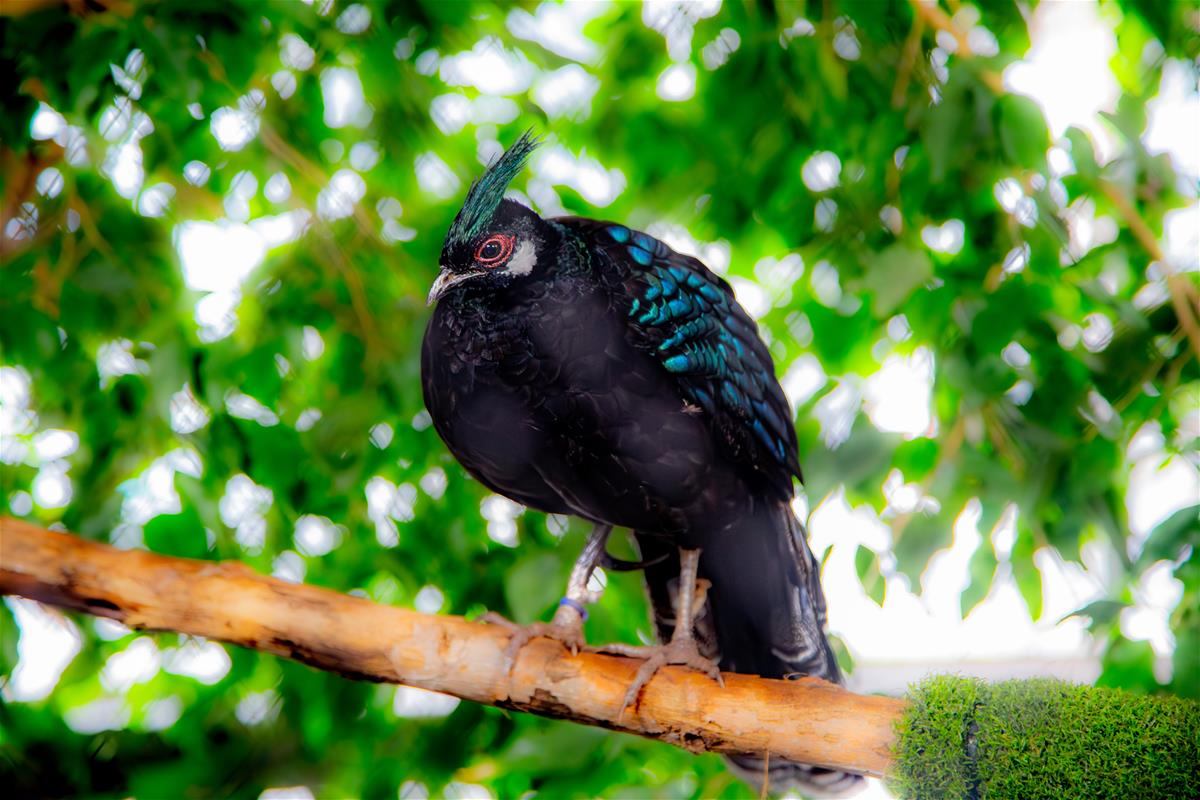
Palawan Peacock-pheasant
Polyplectron napoleonis
The Palawan Peacock-pheasant is a medium-sized, ground-dwelling bird renowned for its iridescent blue-green eyespots and finely patterned plumage. Adults typically measure 45 to 50 centimetres in length. Males are especially striking, with metallic blue and green ocelli on the wings and tail, a glossy dark body, and a white throat bordered by black markings. Females are more subdued in colour, with mottled brown plumage that provides camouflage on the forest floor.
This species is shy and secretive, spending much of its time walking quietly through dense undergrowth. When disturbed, it prefers to retreat rather than take flight. In zoological settings, the Palawan Peacock-pheasant often captures attention through close viewing, where its intricate feather patterns and subtle iridescence can be fully appreciated.
HEAD AND BODY LENGTH
Approximately 45–50 centimetres.
WEIGHT
Adults generally weigh between 500 and 750 grams.
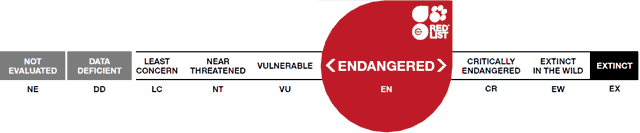
Conservation Status: IUCN
Distribution
Confined exclusively to Palawan Island, Philippines, where it occurs at low to mid elevations.
Habitat
Inhabits lowland and foothill tropical forests, particularly areas with dense understory and leaf litter. It is strongly associated with intact forest interiors and avoids heavily disturbed or open areas.
Diet
Omnivorous. Feeds on seeds, fallen fruit, leaves, insects, worms, and other small invertebrates encountered while foraging on the forest floor. Its diet reflects the seasonal availability of forest resources.
Reproduction
Breeding biology in the wild is not extensively documented. Females typically lay 1 to 2 eggs in a shallow ground nest concealed by vegetation. Chicks are precocial and leave the nest shortly after hatching, following the female while learning to forage.
Adaptations
The species’ intricate plumage serves multiple functions: males use their eyespots in courtship displays, while the overall dark and patterned colouring helps break up the body outline in shaded forest environments. Strong legs support ground-based movement, and cautious behaviour reduces exposure to predators. The ability to remain motionless for long periods enhances camouflage.
Threats to Survival
Primary threats include deforestation, habitat fragmentation, and hunting or trapping. Because populations are isolated and confined to a single island, recovery is slow once declines occur. Climate change may further affect forest structure and food availability over time.