Viewable
Malacostraca
Location at the Zoo
Americas
Global Range
North America
Northern Clearwater Crayfish
Faxonius propinquus
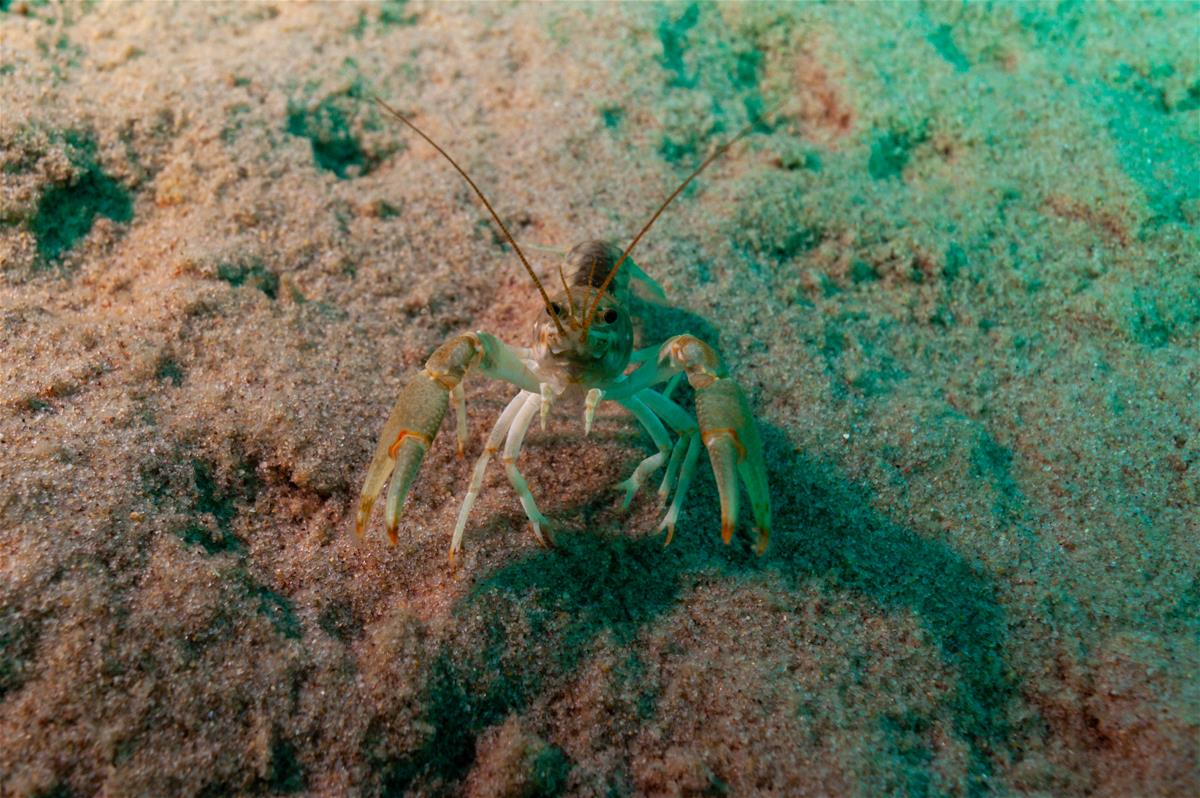
The Northern Clearwater Crayfish is a relatively small freshwater crustacean with a hard, segmented exoskeleton, five pairs of walking legs and a pair of large claws. Its colour usually ranges from olive-green and brown to reddish-brown, helping it blend into rocky stream and lake bottoms. A dark, saddle-shaped marking commonly crosses the upper surface of the abdomen, while the tips of the claws are often orange or red with a dark band immediately behind them.
Adults generally have a carapace—the hard shell covering the head and thorax-measuring about 2.5 to 3.5 centimetres long, although unusually large individuals may approach four centimetres in carapace length. The entire animal is longer when its abdomen and claws are included. Like other crayfish, it must periodically shed its exoskeleton to grow, leaving it temporarily soft and vulnerable after moulting.
Northern Clearwater Crayfish are usually active along the bottom, where they shelter beneath rocks and debris. They are an important part of freshwater food webs, consuming plant and animal material while also serving as prey for fish, turtles, birds and mammals.
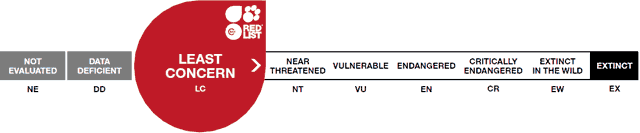
Conservation Status: IUCN
Distribution
The Northern Clearwater Crayfish is native to the Great Lakes and many surrounding drainage systems in Canada and the United States. Its Canadian distribution is centred in Ontario and Quebec. In the United States, its native range extends from the northeastern states west to southern Minnesota and northeastern Iowa and south through much of Illinois and Indiana. Introduced populations have been recorded in several watersheds outside this natural range.
Habitat
This species occurs in lakes, rivers and permanent streams but is especially associated with clear, cool, flowing water over rocky substrates. It commonly shelters beneath large stones, submerged wood and other debris in shallow crevices.
Unlike some crayfish that dig deep burrows to survive drought, the Northern Clearwater Crayfish is a poor burrower and depends on permanent water. Falling water levels and the drying of streams can therefore cause significant mortality.
Diet
The Northern Clearwater Crayfish is an omnivorous and opportunistic feeder. Its diet includes filamentous algae, seeds, aquatic vegetation and insect larvae such as mayflies, stoneflies, midges and craneflies. It may also eat snails and other small molluscs, including young Zebra Mussels where they occur. By processing plant material and consuming small animals, crayfish help transfer energy and nutrients through freshwater ecosystems.
Reproduction
Mating generally occurs during fall or early spring, although timing varies with latitude and local water temperature. Females produce approximately 150 to 300 eggs in spring and carry them beneath the abdomen, attached to specialized appendages called swimmerets. The eggs usually hatch within four to six weeks.
Newly hatched crayfish remain attached to the female for approximately two weeks before becoming free-swimming and independent. Many reach maturity by their first autumn. Individuals commonly live for about two years, although some may survive for as long as four years.
Adaptations
Its mottled colouration and dark abdominal saddle provide camouflage against rocks, gravel and submerged vegetation. Large claws are used to capture food, manipulate objects and defend against predators or competing crayfish. Long antennae and other sensitive appendages help it investigate its surroundings and locate food where visibility is limited.
Its flattened body allows it to squeeze beneath rocks, while the muscular abdomen and broad tail fan can produce a rapid backward escape when the animal is disturbed. The hard exoskeleton provides protection but must be shed as the crayfish grows.
Threats to Survival
Although the species remains secure overall, local populations may be affected by invasive crayfish, water pollution, sedimentation and alterations to streams and shorelines. The spread of the larger and more aggressive Rusty Crayfish is a particular concern because it can displace Northern Clearwater Crayfish from shelter and feeding habitat and may hybridize with them.
Water-level reductions are another risk because this species cannot construct the deep burrows needed to survive when its habitat dries. Moving live crayfish between water bodies—particularly through bait release—can also spread crayfish beyond their natural ranges and disrupt local freshwater communities.