Viewable
Actinopterygii
Location at the Zoo
Australasia
Global Range
Indo-Pacific
Mimic Surgeonfish
Acanthurus pyroferus
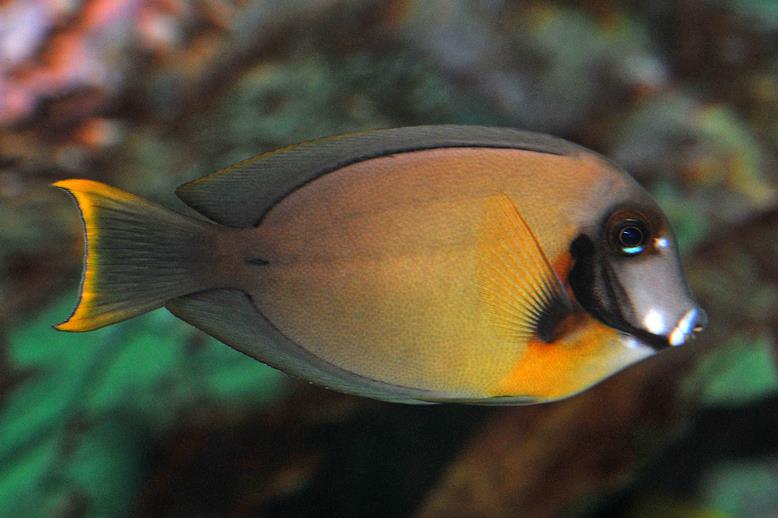
The Mimic Surgeonfish is a medium-sized reef fish best known for its unusual ability to change its appearance during its lifetime. Juveniles closely resemble other, often more toxic or less palatable fish species—such as angelfish—gaining protection from predators through imitation. As they mature, they gradually lose this disguise and develop the more typical shape and colouration of a surgeonfish, usually becoming brown to yellowish with subtle markings.
Adults typically reach 20 to 25 centimetres in length. Like other surgeonfish, they have a laterally compressed body and a sharp, scalpel-like spine near the base of the tail, which can be used defensively. In aquarium settings, this species is often highlighted for its fascinating example of mimicry and how survival strategies can change over time.
HEAD AND BODY LENGTH
Typically 20–25 centimetres.
WEIGHT
Generally a few hundred grams, depending on age and condition.
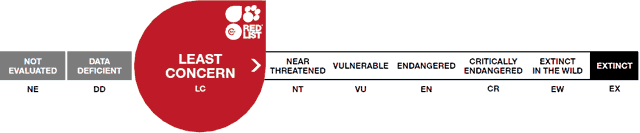
Conservation Status: IUCN
Distribution
Occurs widely across the Indo-Pacific region, from East Africa to the central Pacific islands, including Australia and Southeast Asia.
Habitat
Inhabits coral reefs, particularly lagoons and reef slopes where there is a mix of coral and algae. Juveniles are often found in sheltered reef areas where their mimicry is most effective, while adults may range more widely across reef systems.
Diet
Primarily herbivorous, feeding on algae and plant material growing on reef surfaces. Juveniles may consume more varied foods, including small invertebrates, before transitioning to a more algae-based diet as they mature.
Reproduction
Like many reef fish, the Mimic Surgeonfish is a broadcast spawner. Eggs and sperm are released into the water column, where fertilization occurs externally. Larvae drift with ocean currents before settling onto reefs as juveniles.
Adaptations
The most notable adaptation is juvenile mimicry, where young fish imitate the appearance of other species to avoid predation. This strategy is gradually abandoned as the fish grows larger and less vulnerable. The sharp tail spine provides defence, while a laterally compressed body allows efficient movement through reef structures.
Threats to Survival
Primary threats include coral reef degradation, climate change, and localized collection for the aquarium trade. Because the species depends on healthy reef systems, long-term reef decline could impact populations.