Viewable
Location at the Zoo
African Rainforest
Global Range
Africa
Mantella (Poison Frog)
Mantella spp.
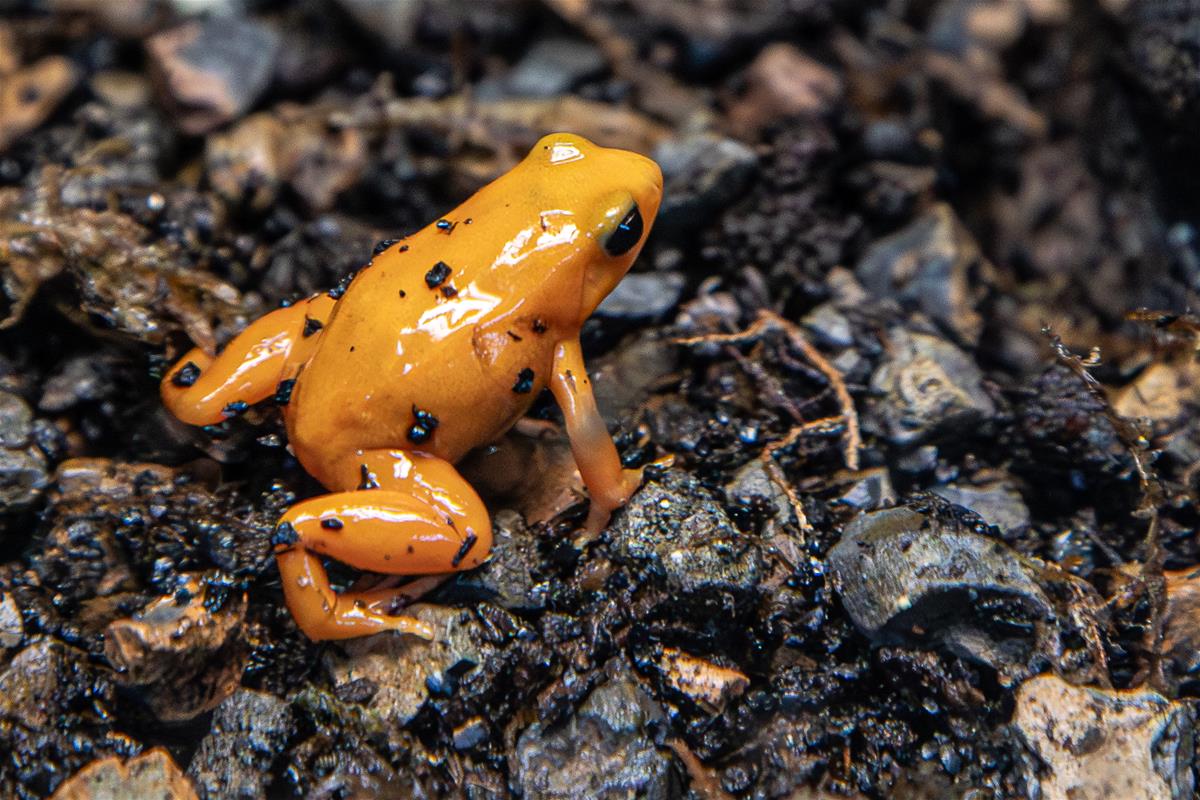
Mantellas are a group of small, brightly coloured frogs native exclusively to Madagascar. Often compared to poison dart frogs due to their vivid colouration, mantellas display striking combinations of yellow, orange, red, green, black, and blue, depending on the species. Most adults measure 2 to 3.5 centimetres in length. Despite their small size, their bold appearance makes them some of the most visually recognizable amphibians of Madagascar.
Unlike many tropical frogs, mantellas are diurnal, meaning they are active during the day. They are typically seen moving along the forest floor, among leaf litter, or near shallow water. Their bright colours function as a warning signal to predators, advertising the presence of toxic skin secretions. In zoo settings, mantellas are frequently used to highlight Madagascar’s extraordinary endemism and the conservation challenges facing amphibians worldwide.
HEAD AND BODY LENGTH
Typically 2–3.5 centimetres.
WEIGHT
Very light; usually only a few grams.
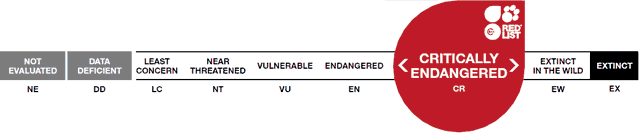
Conservation Status: IUCN
Distribution
Restricted entirely to Madagascar, with individual species occupying specific forest types or geographic regions. No mantellas occur naturally outside the island.
Habitat
Mantellas inhabit a range of environments, including humid rainforests, dry deciduous forests, montane forests, and forest edges. Most species are associated with leaf litter, mossy ground cover, or areas near shallow pools and streams used for breeding. Many are sensitive to microclimate changes, particularly humidity and temperature.
Diet
Carnivorous. Feeds primarily on ants, mites, termites, and other small invertebrates. Mantellas acquire their skin toxins from chemicals found in their natural prey, particularly ants. In captivity, where this diet is absent, they are non-toxic.
Reproduction
Reproductive strategies vary among species. Eggs are typically laid on land in moist leaf litter or sheltered areas near water. After hatching, tadpoles are transported or washed into nearby pools, where they complete development. Breeding activity is often seasonal and closely linked to rainfall.
Adaptations
Bright colouration functions as aposematic signalling, warning predators of toxicity. Diurnal activity allows visual signalling to be effective. Small body size and agility support movement through dense ground cover. Reliance on specific prey for toxin acquisition highlights a close ecological relationship between mantellas and their environment.
Threats to Survival
Primary threats include deforestation, agricultural expansion, mining, and habitat fragmentation. Climate change poses additional risks by altering rainfall patterns and forest humidity. Illegal collection historically impacted some species, though regulation and captive breeding have reduced this pressure. Because many species occupy extremely limited ranges, they are particularly vulnerable to localized disturbances.