Viewable
Location at the Zoo
Malayan Woods
Global Range
Indomalaya
Malayan Walking Stick
Lonchodes brevipes
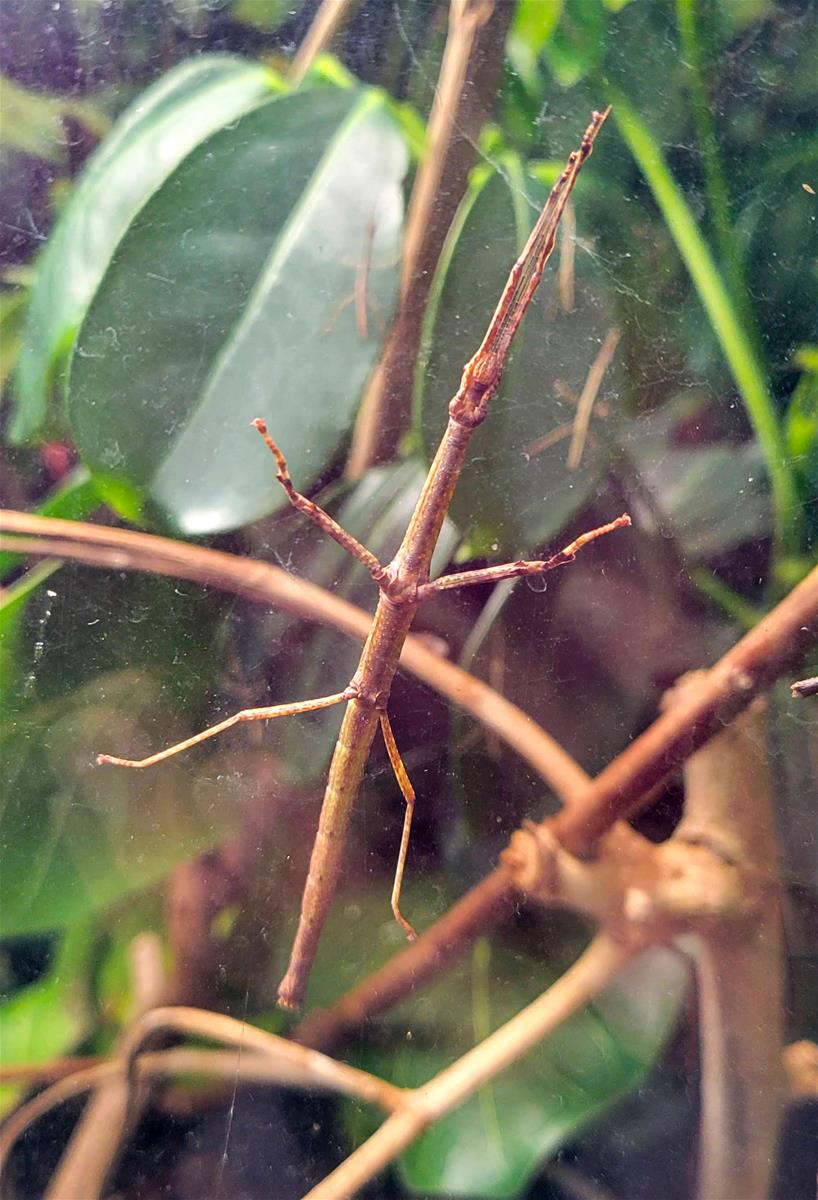
The Malayan Walking Stick (Lonchodes brevipes) is a slender, twig-mimicking insect specialized for camouflage in dense tropical vegetation. Adults are elongated and narrow-bodied, typically measuring 10 to 13 centimetres in length. Colouration ranges from light brown to dark green or grey, often matching the tones of surrounding branches and leaves. When at rest, the insect aligns its body and legs to resemble a thin stick, making it extremely difficult to detect.
This species is primarily nocturnal. During the day, individuals remain motionless among foliage, relying on camouflage rather than movement to avoid predators. In zoo and insect house settings, it is often overlooked at first glance, which makes it an effective example of extreme visual mimicry and insect survival strategies.
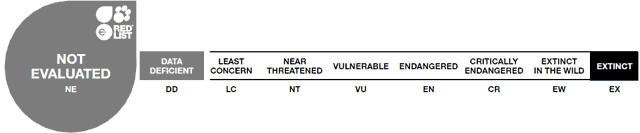
Conservation Status: IUCN
Distribution
Documented primarily in Malaysia, with possible wider distribution in adjacent parts of Southeast Asia. Precise range boundaries are not well defined, as many stick insect species are under-recorded in the wild.
Habitat
Inhabits tropical rainforest and forest-edge environments, particularly areas with dense understory vegetation. It is closely associated with shrubs and small trees that provide both food and effective camouflage. High humidity and stable temperatures are important for survival and successful moulting.
Diet
Herbivorous. Feeds on the leaves of various broadleaf plants. In captivity, individuals commonly accept bramble, rose, oak, or other suitable foliage depending on availability. Feeding usually occurs at night, with fresh leaf damage often being the first sign of their presence.
Reproduction
Females lay eggs individually, dropping them to the forest floor where they resemble seeds or plant debris. Eggs may take several months to hatch, depending on environmental conditions. Nymphs emerge as miniature versions of adults and undergo multiple moults as they grow. Like many stick insects, reproduction may occur with or without males, depending on population structure.
Adaptations
Extreme camouflage is the primary adaptation of Lonchodes brevipes. Its body shape, colour, and posture closely imitate twigs, while its slow, deliberate movements reduce detection. When disturbed, individuals may sway gently, mimicking vegetation moved by wind. Nocturnal behaviour further reduces exposure to predators, and egg mimicry helps protect the next generation on the forest floor.
Threats to Survival
The main potential threats include habitat loss from deforestation and reduced availability of host plants. Because this species relies heavily on camouflage rather than defence or mobility, removal of suitable vegetation can significantly affect local populations. Climate changes that alter humidity levels may also impact development and egg survival.