Viewable
Location at the Zoo
African Rainforest
Global Range
Southern Pacific
Lau Banded Iguana
Brachylophus fasciatus
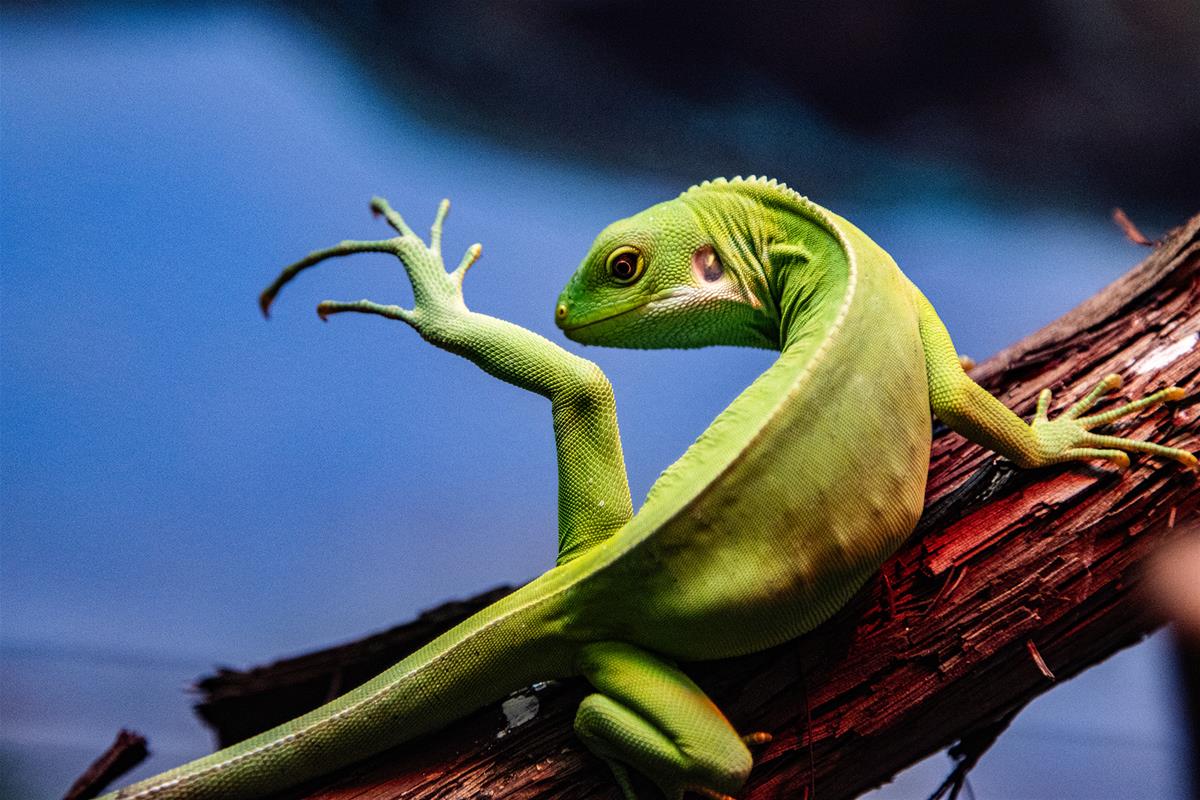
The Lau Banded Iguana is a vividly coloured arboreal lizard best known for the bright green body crossed with bold white or pale blue bands, most pronounced in adult males. These bands give the species its common name and make it one of the most visually striking reptiles of the South Pacific. Adults typically measure 60 to 75 centimetres in total length, including a long, slender tail that aids balance while climbing.
Females are usually greener overall and lack the strong banding seen in males, while juveniles are uniformly green and develop bands as they mature. This species is primarily tree-dwelling and spends much of its life high in the canopy, where its colouration provides effective camouflage among sunlit leaves. In zoological settings, the Lau Banded Iguana is often highlighted for its rarity and its role as an ambassador for island biodiversity.
HEAD AND BODY LENGTH
Body length averages 20 to 25 centimetres, with the tail making up the majority of total length.
WEIGHT
Adults generally weigh between 200 and 300 grams, depending on sex and condition.
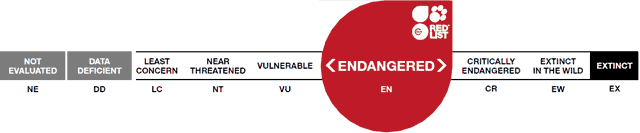
Conservation Status: IUCN
Distribution
Occurs naturally on several islands in eastern Fiji, particularly the Lau Group, and on parts of Tonga. Its distribution is highly fragmented, with populations isolated on individual islands.
Habitat
Inhabits dry and moist tropical forests, coastal woodland, and areas with dense tree cover. It is strictly arboreal and rarely descends to the ground except for nesting. The species relies on intact forest canopies and prefers native vegetation for shelter and food.
Diet
The Lau Banded Iguana is primarily herbivorous, feeding on leaves, flowers, fruits, and shoots from a variety of native plants. Occasional insects may be consumed, particularly by juveniles. Its diet plays a role in seed dispersal and plant regeneration within island forest ecosystems.
Reproduction
Breeding typically occurs during the warmer months. Females descend from the trees to lay clutches of 4 to 6 eggs in shallow nests dug into sandy or soft soil. Eggs incubate for several months, and hatchlings emerge fully independent. Juvenile survival is low in areas with introduced predators, making successful nesting sites critical to population stability.
Adaptations
Bright green colouration provides camouflage in leafy canopies, while the contrasting bands in males may function in social signalling or mate attraction. Strong claws and long toes allow secure movement through branches, and the long tail aids balance. As a diurnal species, it relies on basking to regulate body temperature, moving between sun and shade throughout the day.
Threats to Survival
Major threats include habitat destruction from agriculture and development, predation by introduced mammals, and the effects of climate change on small island ecosystems. Because populations are isolated, local disturbances can quickly lead to declines. Illegal collection has occurred historically but is now tightly regulated.