Viewable
Actinopterygii
Location at the Zoo
Americas
Global Range
North America
Lake sturgeon
Acipenser fulvescens
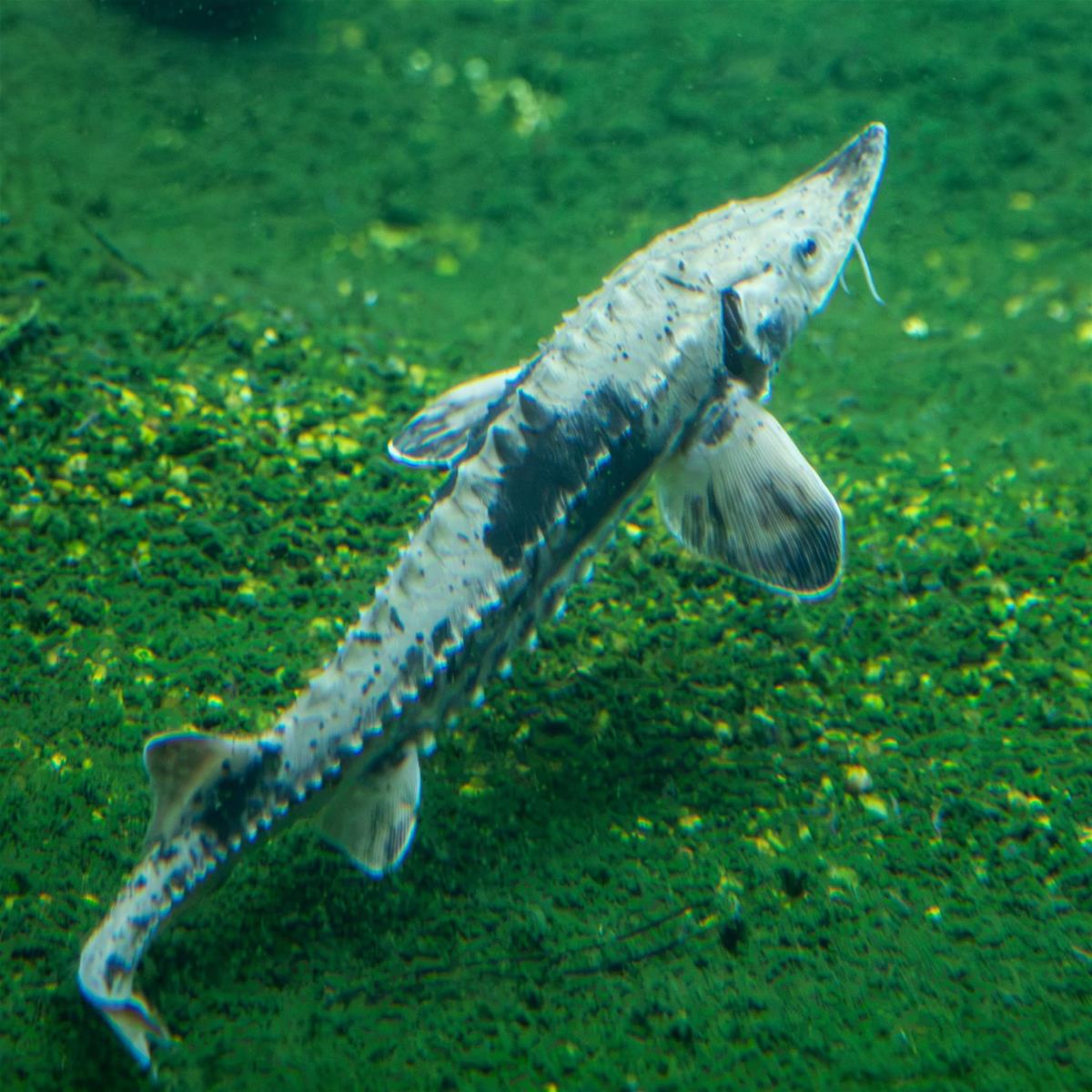
The Lake Sturgeon is one of North America’s largest and longest-lived freshwater fish. Its elongated body is covered by five rows of hard, bony plates called scutes rather than ordinary fish scales. It also has a pointed snout, a shark-like tail and four sensory barbels hanging in front of its mouth. These barbels help locate food along the lake or river bottom. The toothless mouth can extend outward like a short tube, allowing the fish to suck up prey from the substrate.
Adults commonly measure 1.2 to 1.8 metres long and weigh 14 to 36 kilograms, although exceptional individuals may exceed two metres and 90 kilograms. Females can live for more than a century, with an individual from Lake Huron estimated to have reached 155 years of age. Lake Sturgeon have a long-standing cultural and subsistence importance for many Indigenous communities.
HEAD AND BODY LENGTH
Adults are commonly 1.2 to 1.8 metres long, although some may grow beyond two metres.
WEIGHT
Typically 14 to 36 kilograms, with unusually large individuals exceeding 90 kilograms.
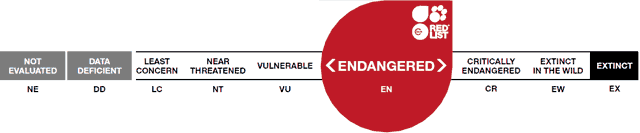
Conservation Status: IUCN
Distribution
Lake Sturgeon occur only in North America. Their range extends through central Canada and the United States, from Alberta east to Quebec and through the Great Lakes, St. Lawrence River, Hudson Bay and Mississippi River drainage systems. Unlike several other sturgeon species, Lake Sturgeon spend their entire lives in freshwater.
Habitat
This species inhabits large lakes and rivers, where adults spend much of their time in deeper water over sand, gravel or mud. During spring, mature fish may travel long distances into rivers and tributaries to reach shallow spawning areas with fast currents and clean rock or gravel. Connections among feeding, spawning, nursery and overwintering habitats are essential throughout their lives.
Diet
Lake Sturgeon feed primarily along the bottom. Their diet includes aquatic insect larvae, worms, snails, mussels, crayfish and other small animals, with fish eggs or small fish sometimes eaten when available. Because they have no teeth, they use their sensitive barbels to locate prey and their extendable mouth to vacuum it from the substrate.
Reproduction
Lake Sturgeon mature remarkably slowly. Males generally begin reproducing between 10 and 18 years of age, while females may not spawn until they are 16 to 30 years old. Adults migrate into fast-flowing rivers during spring and release eggs and sperm over rocky substrates. There is no parental care after spawning. Males may reproduce every one to four years, while females commonly spawn only once every two to six years.
Adaptations
Rows of bony scutes protect the body while allowing the fish to remain flexible in moving water. Four barbels and a highly sensitive snout help detect food in dark or cloudy conditions, while the protrusible mouth is specialized for suction feeding. A powerful, asymmetrical tail provides propulsion during long migrations and against strong river currents. Its slow metabolism and long lifespan allow it to survive for decades, but these same traits make populations slow to recover from losses.
Threats to Survival
Lake Sturgeon are threatened by dams and other barriers that block spawning migrations, alteration of river flows, destruction or sedimentation of spawning beds, water pollution, accidental capture in fishing gear and historical overharvesting. Their late maturity and infrequent reproduction mean the loss of even a small number of breeding adults can affect a population for decades. Restoration work includes protecting spawning habitat, improving river connectivity, monitoring populations and rearing young fish for carefully planned reintroductions.