Viewable
Reptile
Location at the Zoo
African Rainforest
Global Range
Africa
Gaboon viper
Bitis gabonica
Order: Squamata
Family: Viperidae
Genus: Bitis
This is a magnificent African venomous snake. Colours and patterns are truly stunning; they form symmetrical designs which create various unique patterns on the scales. The body is beautifully coloured in various shades of dark and light brown, buff, purple, and pink. Combinations of these colours form geometric patterns along the length of the snake’s back. A broad buff vertebral stripe is broken into quadrangular shapes neatly aligned over the center of the back. Between each of these are dark, yellow-edged hourglass shapes. The flanks have a series of fawn or brown rhomboidal shapes, with light vertical central bars. Adjacent to these and also along the sides are complex triangular patterns which are brown and purple. In between the series of triangles are yellow and purple areas. The ventral side (or belly) is a light yellow colour with dark spots sprinkled throughout.
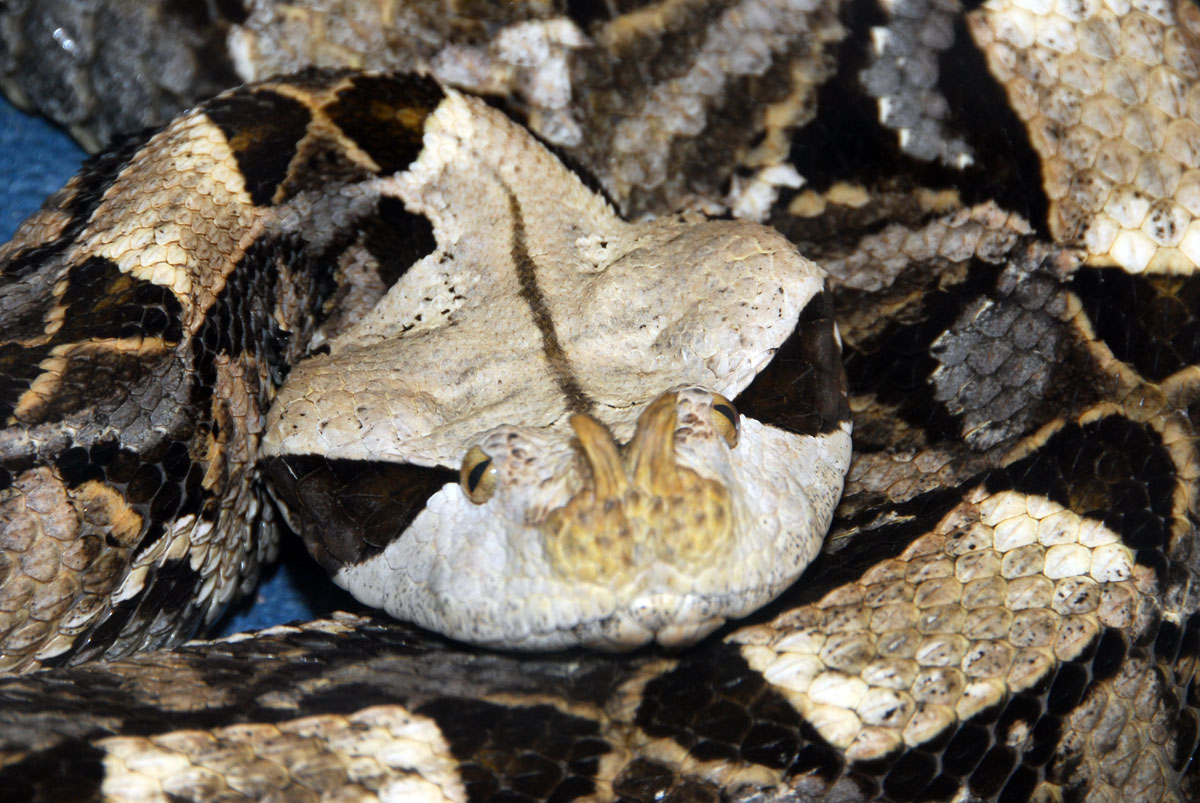
The Gaboon viper has a large and distinctive triangular-shaped head which also emphasizes the colours of its body. The head is buff or cream with a fine, dark central line. They have dark brown to black spots on the rear corners above the angle of the jaw. There is a dark triangle behind and below each eye. The apex of the triangle enters the eye, while the base borders the upper lip. The triangle may be divided into two by an oblique light line, which radiates from the eye. The iris colour is cream, yellow-white, orange, or silvery.
There are two subspecies. The West African, B. g. rhinoceros has large nasal horns and a single triangle beneath each eye. The East African, B. g. gabonica has small nasal horns and the dark triangular marking leading back from the eye towards the angle of the mouth is divided into two.
This is the heaviest snake in the viperidae family and is the heaviest venomous snake in Africa. They weigh 8 kg. Females are generally larger, and heavier, than their male counterparts. Weights
exceeding 8 kg have been recorded. Length is up to two metres.
The Gaboon viper has a large and distinctive triangular-shaped head which also emphasizes the colours of its body. The head is buff or cream with a fine, dark central line. They have dark brown to black spots on the rear corners above the angle of the jaw. There is a dark triangle behind and below each eye. The apex of the triangle enters the eye, while the base borders the upper lip. The triangle may be divided into two by an oblique light line, which radiates from the eye. The iris colour is cream, yellow-white, orange, or silvery.
There are two subspecies. The West African, B. g. rhinoceros has large nasal horns and a single triangle beneath each eye. The East African, B. g. gabonica has small nasal horns and the dark triangular marking leading back from the eye towards the angle of the mouth is divided into two.
This is the heaviest snake in the viperidae family and is the heaviest venomous snake in Africa. They weigh 8 kg. Females are generally larger, and heavier, than their male counterparts. Weights
exceeding 8 kg have been recorded. Length is up to two metres.
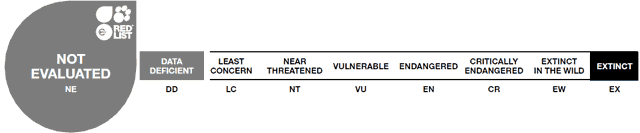
Conservation Status: IUCN
Distribution
Gaboon vipers are widely distributed across the equatorial belt of Africa. They occur in the rainforests of central and western Africa. The two subspecies occupy different regions. Bitis gabonica rhinoceros is found in West Africa from Ghana west to Guinea, including Sierra Leone, Liberia and Ivory Coast. Bitis gabonica gabonica can be found in Togo, Nigeria, Cameroon, DR Congo, Central African Republic, southern Sudan, Uganda, Kenya, eastern Tanzania, Zambia, Malawi, eastern Zimbabwe, Mozambique, and northeast KwaZulu-Natal Province in South Africa.Habitat
They are usually found in rainforests and nearby woodlands, mainly at low altitudes, but sometimes as high as 1500 m. In Tanzania, this species is found in secondary thickets, cashew plantations, and in agricultural land under bushes and in thickets. In Uganda, they are found in forests and nearby grasslands. They also do well in reclaimed forest areas: cacao plantations in West Africa and coffee plantations in East Africa. They have been found in evergreen forests in Zambia. In Zimbabwe, they only occur in areas of high rainfall along the forested escarpment in the east of the country. In general they may also be found in swamps, as well as in still and moving waters. They are commonly found in agricultural areas near forests and on roads at night.Diet
They feed on a variety of small mammals and birds. Prey items include different species of rodents as well as hares and rabbits. They are, for the most part ambush predators. They are well camouflaged by leaf litter and spend long periods of time motionless, waiting for suitable prey to come within striking distance.Reproduction
Mating usually begins during the rainy season. During this period of sexual activity males engage in ritualized combat. This starts with one male rubbing its chin along the back of the other. The second male will then raise its head as high as possible and the necks intertwine. When the heads are level, they turn towards each other and push. Their bodies intertwine as they switch positions. They become oblivious to everything else, continuing even after they fall off of a surface or into water. Sometimes they intertwine and squeeze so tightly that their scales stand out from the pressure. They have also been observed to strike at each other with mouths closed. Occasionally, the combatants will tire and break off the fight by "mutual consent", resting for a while before resuming once more. The event is settled when one becomes exhausted and one of the two succeeds in pushing the other's head to the ground and raising its own by 20 - 30 cm. The dominant male will mate with the female.The gestation period is from seven months up to one year. Gaboon vipers are ovoviviparous. Ovoviviparity means that the young develop within an egg membrane, and are nourished by the egg yolk, but instead of being incubated externally, the eggs are retained within the body until they are ready to hatch. The average litter size is between 15 - 47 young. Litters of 63 young have been recorded. Neonates (newborns) are perfect replicas of the adults. They care for themselves soon after birth. They are 23 - 37 cm in length and weigh 25 - 45g.
Adaptations
The Gaboon viper has the longest fangs of any venomous snake in the world (2.5 - 4 cm). They have "front-hinged" fangs situated at the front of the mouth which fold into the roof of the mouth within a protective sheath when the mouth is closed. When the mouth opens the fangs unfold outwards, similar to the action of a "switch-blade". As a result, these hollow venom conducting fangs can deliver a large quantity of venom with a single bite.Along with its formidable fangs, the Gaboon viper also has enormous venom glands which produce the largest quantity of venom of any snake. The venom is cytotoxic (tissue destroying). It is a combination of hemotoxin and cardiotoxin, effecting both the blood vessels and the heart. They can strike with lightning fast speed and often retain their hold on their victim until the toxic venom does its job.
The eyes are large, moveable, set well forward, and they enable the snake to look forwards and backwards at the same time, creating a wider range of eye movement than other snakes. In general, the eyes often flick back and forth in a rapid and jerky manner. When asleep, there is no eye movement and the pupils are strongly contracted. The pupils dilate suddenly and eye movement resumes when the animal wakes up. They are not an aggressive snake, however, if threatened they may hiss loudly as a warning, doing so in a deep and steady rhythm, slightly flattening the head at the expiration of each breath.
As an ambush predator they tend to take shelter in the leaf litter of forest floors. The colour pattern gives it excellent camouflage. When it lies perfectly still among the fallen leaves of a forest floor, it becomes nearly invisible. This "disappearing act" complements the sit-and-wait hunting strategy used by the Gaboon viper. It is so well hidden, prey walk right in front of it. Then it will lunge forward and sink its fangs into the animal, delivering its potent venom. When the prey stops moving, the Gaboon viper will begin to eat. The venom also aids with the digestive process.