Demoiselle crane
Anthropoides virgo
Order: Gruiformes
Family: Gruidae
Genus: Anthropoides
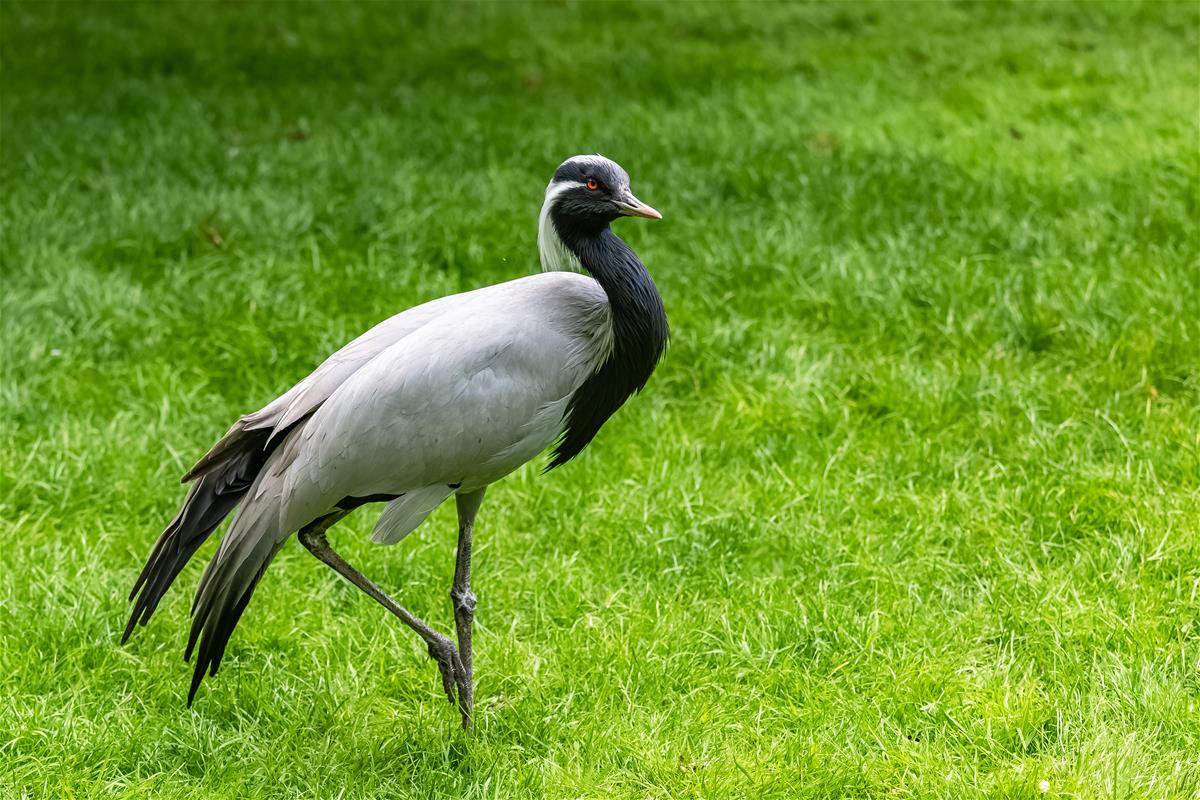
Compared to other species, these are the smallest cranes with the male being slightly smaller than the female. They stand about 90 cm tall, weigh between 2000- 3000 g and have a wingspan of 150-170 cm. The Demoiselle Crane and the Anthropoides paradisea are the only cranes with an entirely feathered head, with no red skin showing. They are uniformly gray, except for a black head and neck and have distinctive, secondary black tipped white ear tufts extending from behind the eye to the upper nape. Elongated black plumage tinged with reddish-orange hangs down below the breast. Juveniles are generally a duller grey with paler, less distinct ear tufts.
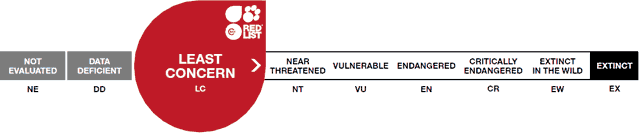
Conservation Status: IUCN
Distribution
The Demoiselle Crane is the second most abundant of the world’s cranes with a total population estimated at 200-240,000 birds. Only the Sandhill Crane is more numerous. The three eastern populations; eastern Asia, Kazakhstan/Central Asia and Kalmykia are most abundant, numbering tens of thousands of birds. The Black Sea populations in Romania, Moldova and the Ukraine are approximately 500 birds each and declining. They tend to winter in the Indian subcontinent and sub-Saharan Africa ranging from Chad to Ethiopia. Small, disjunctive, breeding populations can be found in Turi in the Atlas mountains, NW Africa.
Habitat
Their habitat is primarily savanna, steppe and other grassland types, often in close proximity to streams, low lakes and other wetlands. They may inhabit semi-desert and true deserts but only where water is available. They have been found nesting as high as 3000 m above sea level in mountain valleys and the steppes of Kirghizia.
Diet
They feed mainly on grass seeds and other plant material as well as insects, especially beetles ( Coleoptera), worms, lizards and other small vertebrates. They also forage in cultivated fields for cereal grains, peanuts and beans sometimes causing damage to cereal and legume crops.
Reproduction
They breed mainly in Oct-Dec however, on occasion as late as March. They nest primarily in grassland near water but also in pastures, crop fields and marshes. The nest is a platform of small stones and wetland vegetation of sufficient height to conceal them and the nest but short enough to allow them to look out while incubating. There are usually two eggs; incubation is 27-29 days. The chicks are pale brown above, grayish-white below and fledge within 55-65 days, the shortest period in any crane. During the pre-fledging period, adults and chicks can cover considerable distances in search of food. After the chicks fledge, the cranes gather in flocks and move to agricultural fields, where food is more abundant. Sexual maturity is reached in the second year.
Adaptations
By early autumn, most Demoiselle Cranes from central Asia, Mongolia and China have arrived at their wintering grounds in the Indian subcontinent after having made significant sea crossings; the Red Sea and eastern Mediterranean. They use agricultural fields, roost in nearby shallow waters, depressions and other natural wetlands. Birds from the Black Sea and Kalmykia winter in Sudan and other parts of northeastern Africa populating the Acacia savanna, grassland and riparian wetlands.
Threats to Survival
Although not globally threatened (CITES 11), during the past century, these birds have been extirpated from the Iberian Peninsula, the Balkans and parts of north Africa and west Eurasia. This primarily through habitat loss, agricultural development and other human disturbances such as the use of pesticides and sport hunting. About 5000 cranes are taken by sport hunters along the migration route through Afghanistan and Pakistan, every year. Extensive research and conservation efforts are being undertaken throughout the range over the last 20 years to stabilize the Demoiselle Crane populations. Incidentally, they breed well in captivity and although no active reintroduction programme is being undertaken presently, it is being considered for those areas where populations are in decline.