Viewable
Location at the Zoo
Australasia
Global Range
Australasia
Crimson Rosella
Platycercus elegans
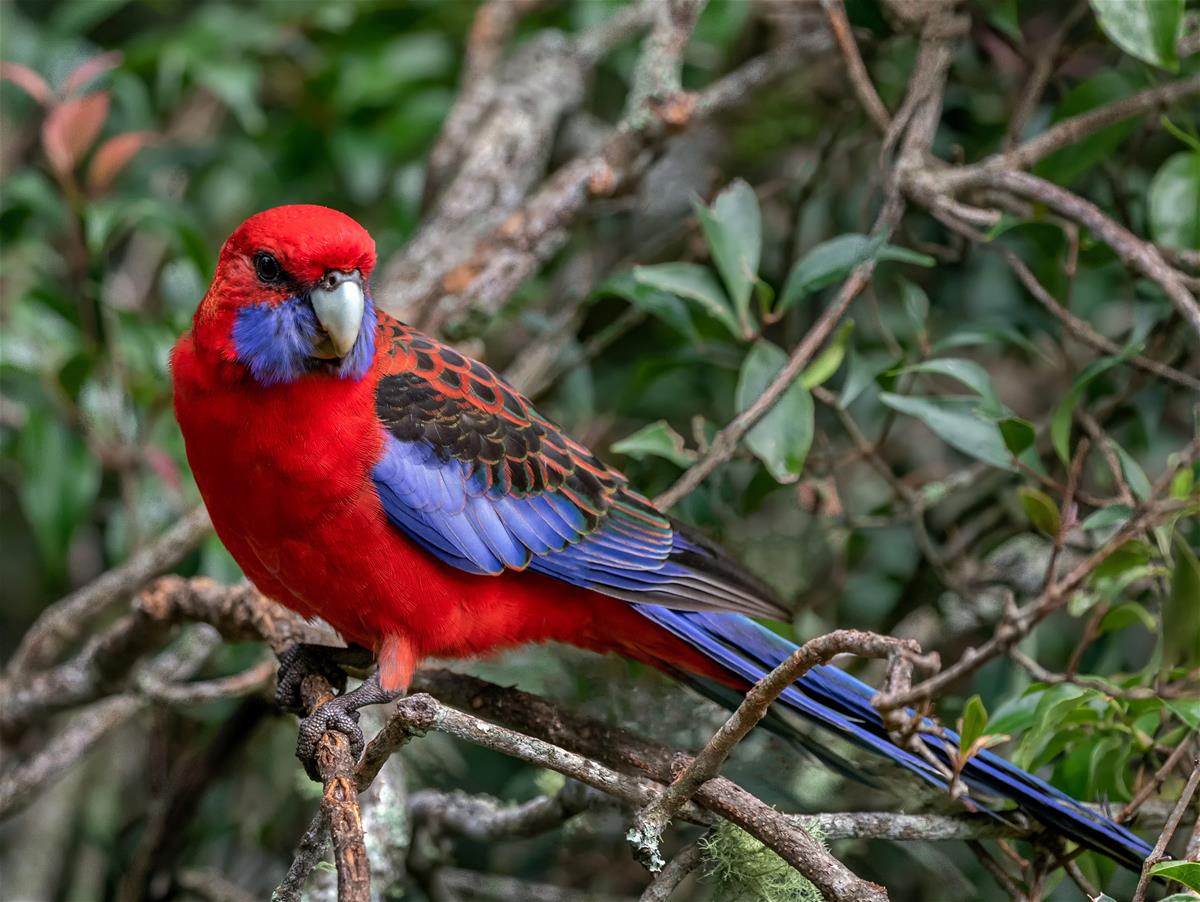
The Crimson Rosella is a medium-sized parrot renowned for its vivid red plumage contrasted with deep blue wings and tail. Adults typically measure 30 to 36 centimetres in length and weigh around 120 to 170 grams. The face and chest are a rich crimson, while the back feathers show subtle black edging, giving the bird a scaled appearance. Several subspecies exist, varying in colour intensity and pattern, including forms with more yellow or orange tones.
This species is confident and vocal, often seen flying between treetops with strong, direct wingbeats or feeding quietly in forest canopies. In zoological settings, the Crimson Rosella is popular with visitors due to its striking colouration and calm, observant behaviour.
HEAD AND BODY LENGTH
Approximately 30–36 centimetres from beak to tail tip.
WEIGHT
Generally between 120 and 170 grams.
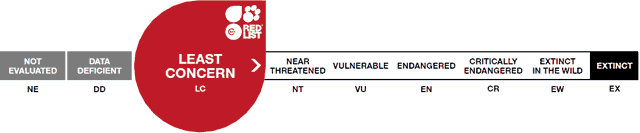
Conservation Status: IUCN
Distribution
Occurs throughout eastern and southeastern Australia, particularly in forested and wooded regions. Its range overlaps with several other rosella species, though habitat preferences help reduce competition.
Habitat
Inhabits eucalypt forests, woodlands, wet sclerophyll forests, and occasionally open grasslands with scattered trees. It relies on tree hollows for nesting and roosting, making old-growth trees an important habitat feature. The species is often found near water sources and along forest edges.
Diet
Feeds on a varied diet of seeds, fruits, berries, nectar, blossoms, and occasionally insects and larvae. Foraging occurs both in trees and on the ground. Its strong, curved beak allows it to crack hard seeds and manipulate a wide range of food items.
Reproduction
Breeding usually takes place from September to January. Nests are established in tree hollows, where the female lays 3 to 8 eggs. Incubation lasts around 19 to 21 days, and chicks remain in the nest for about five weeks. Both parents contribute to feeding the young once they hatch.
Adaptations
Bright plumage plays a role in social communication and mate recognition. Strong wings support efficient long-distance flight between feeding sites. A robust beak enables a flexible diet, while behavioural adaptability allows the species to thrive in both natural forests and human-modified environments. Reliance on tree hollows has shaped its association with mature woodland ecosystems.
Threats to Survival
Primary threats include loss of nesting hollows due to land clearing and removal of old trees, competition with introduced species for nest sites, and local impacts from urban development. However, these pressures are not currently severe enough to threaten the species at a population level.