Cattle egret
Ardeola ibis
Order: Ciconiiformes
Family: Ardeidae
Genus: Ardeola
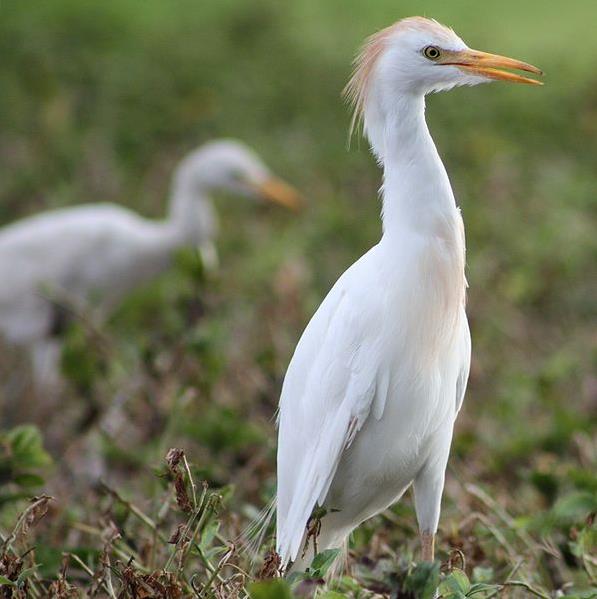
The non-breeding adult has mainly white plumage, a yellow bill and grayish-yellow legs. During courtship a buff wash appears over much of its body and the legs turn reddish. The sexes are similar, but the male is marginally larger and has slightly longer breeding plumes. Juveniles lack coloured plumes and have a black bill. It is a stocky heron with a short, thick neck, a sturdy bill, and a hunched posture. Adults are 46 – 56 cm in length, with a wing span of 88 – 96 cm. They weigh between 270 – 512 g.
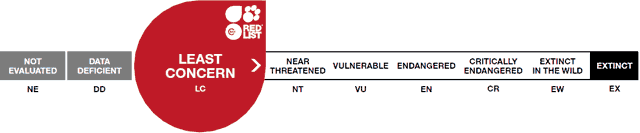
Conservation Status: IUCN
Distribution
Africa and Madagascar, SW Europe to the Caspian Sea, North, Central and South America from Canada to NE Argentina and scattered parts of Brazil, Seychelles, South and East Asia to Australia and New Zealand. It is a very cosmopolitan species.
Habitat
It is found in the tropics, subtropics, and warm temperate zones. Flocks occupy open grassy areas, meadows, fresh water swamps, rice fields, pastures, often alongside hoofed livestock. It is the least aquatic of herons occurring regularly in dry, arid fields, semi-arid areas where it may remain for long periods of time far away from water. It also appears in suburban zones; golf courses or even towns. Some populations are migratory.
Diet
Mainly insects; locusts, grasshoppers, caterpillars, beetles, dragonflies, and cicadas. They also feed on frogs, tadpoles, mollusks, fish, crustaceans, lizards, small birds, and rodents. They, slowly, follow cattle, water buffalo and other large mammals that are stirring up food by their movement or are carrying it. They even follow farm tractors. In Africa, they attend forest or savanna fires capturing fleeing insects. They are active, gregarious feeders assembled in loose flocks of a dozen or more birds but may gather in the hundreds or even thousands when food is abundant. They are opportunistic and non-competitive feeders.
Reproduction
Nesting season varies according to food availability. In the temperate north, nesting occurs in spring and summer. In the tropics it occurs at the end of the rainy season when the grasslands are drying out. The cattle egret is a highly colonial bird breeding in colonies of a few hundred pairs to several thousands. The nests are made of reeds, twigs, or branches about 40 cm wide and up to 20 m off the ground. The nests are not necessarily near water. The eggs are white with a pale green or blue tinge, oval shaped, and somewhat pointed. A clutch usually contains four to five eggs. Incubation lasts about 24 days. The parents share the care of the chicks. The young, covered in white down, are guarded for about ten days then they leave the nest but stay on nearby branches for another two weeks. They fledge at 30 days. They are fully independent after another 15 days. Nesting success is fairly high.
Adaptations
The cattle egret heron is among the most social of herons forming small or large flocks on their feeding grounds. They walk slowly adjacent to moving cattle or other hoofed animals and may even perch on these animals to move from place to place (and keep them free of insects at the same time). Their gait is characteristic of the species; the head is alternatively pulled forward and withdrawn with each step. They are mostly sedentary, however, certain populations are partial or total migratory particularly in SW Europe, NE Asia, and Australia. This is often in connection with rains and available food sources. They are highly prone to vagrancy over long distances ending up in Alaska, Scandinavia, Iceland, and even Antarctica. The positioning of the egret’s eyes allows for binocular vision during feeding. Physiological studies suggest that the species may be capable of crepuscular or nocturnal activity. This species gives a quiet, throaty “rick-rack” call at the breeding colony, but is otherwise largely silent.
Threats to Survival
Only in Japan are populations declining. Overall, the cattle egret has undergone enormous expansion this century in Africa, SW Europe, South and East Asia and has now colonized on all continents except Antarctica. In America, it has become one of the most common herons.