Temporarily Not Viewable
Location at the Zoo
Australasia
Global Range
Australasia
Brush-tailed Bettong
Bettongia penicillata
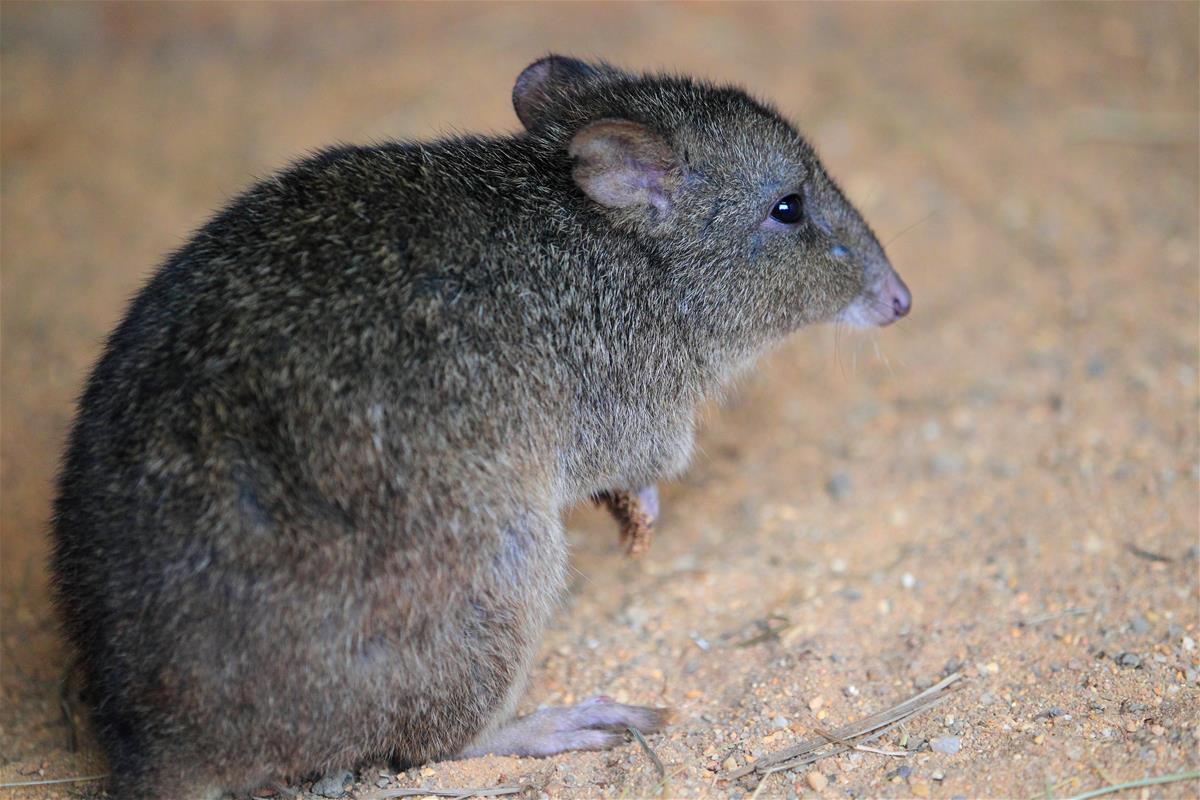
The Brush-tailed Bettong, also known as the Woylie, is a small, nocturnal marsupial sometimes referred to as a “rat-kangaroo” due to its compact body and hopping movement. Adults typically measure 30 to 40 centimetres in body length, with a long, slender tail of similar length ending in a distinctive dark brush. Body weight generally ranges from 1 to 1.6 kilograms. Its fur is soft and grey-brown above with a paler underside, and its large eyes and ears are well adapted for night-time activity.
Once widespread across much of Australia, this species has undergone dramatic population declines. Today, it is best known for its ecological importance rather than its visibility in the wild. In zoological settings, the Brush-tailed Bettong is often highlighted for its role in restoring degraded landscapes and demonstrating the importance of small mammals in healthy ecosystems.
HEAD AND BODY LENGTH
Approximately 30–40 centimetres.
WEIGHT
Typically 1–1.6 kilograms.
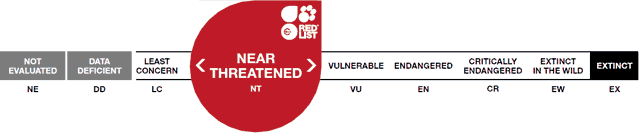
Conservation Status: IUCN
Distribution
Historically widespread across southern and central Australia; currently found in southwestern Western Australia, with reintroduced populations in parts of South Australia, New South Wales, and on predator-free islands and fenced sanctuaries.
Habitat
Occupies open woodlands, shrublands, and heathlands, particularly areas with loose soil suitable for digging and abundant ground cover. It shelters during the day in shallow nests made from grass and bark, often hidden under shrubs or fallen logs.
Diet
The Brush-tailed Bettong feeds primarily on fungi, especially underground truffles, as well as roots, tubers, seeds, and other plant material. Insects may be eaten occasionally. By digging for food, it turns over soil and spreads fungal spores, playing a crucial role in soil health, nutrient cycling, and plant regeneration.
Reproduction
This species has a high reproductive potential. Females can breed year-round in favourable conditions and typically give birth to a single young at a time. The joey spends about three months in the pouch before emerging and is weaned several weeks later. Females are capable of embryonic diapause, allowing them to pause development until conditions are suitable.
Adaptations
Strong forelimbs and claws enable efficient digging for food and nest construction. The long tail provides balance during hopping and is used to carry nesting material. Nocturnal behaviour reduces exposure to predators and heat. Its reliance on fungi has shaped both its foraging behaviour and its ecological importance, making it a key contributor to ecosystem function.
Threats to Survival
The primary threats are predation by introduced foxes and cats, habitat degradation, inappropriate fire regimes, and competition with introduced herbivores. Without active management, populations decline rapidly, highlighting the species’ vulnerability despite its adaptability in predator-free environments.