Viewable
Location at the Zoo
Australasia
Global Range
Indomalaya
Black tree monitor
Varanus beccarii
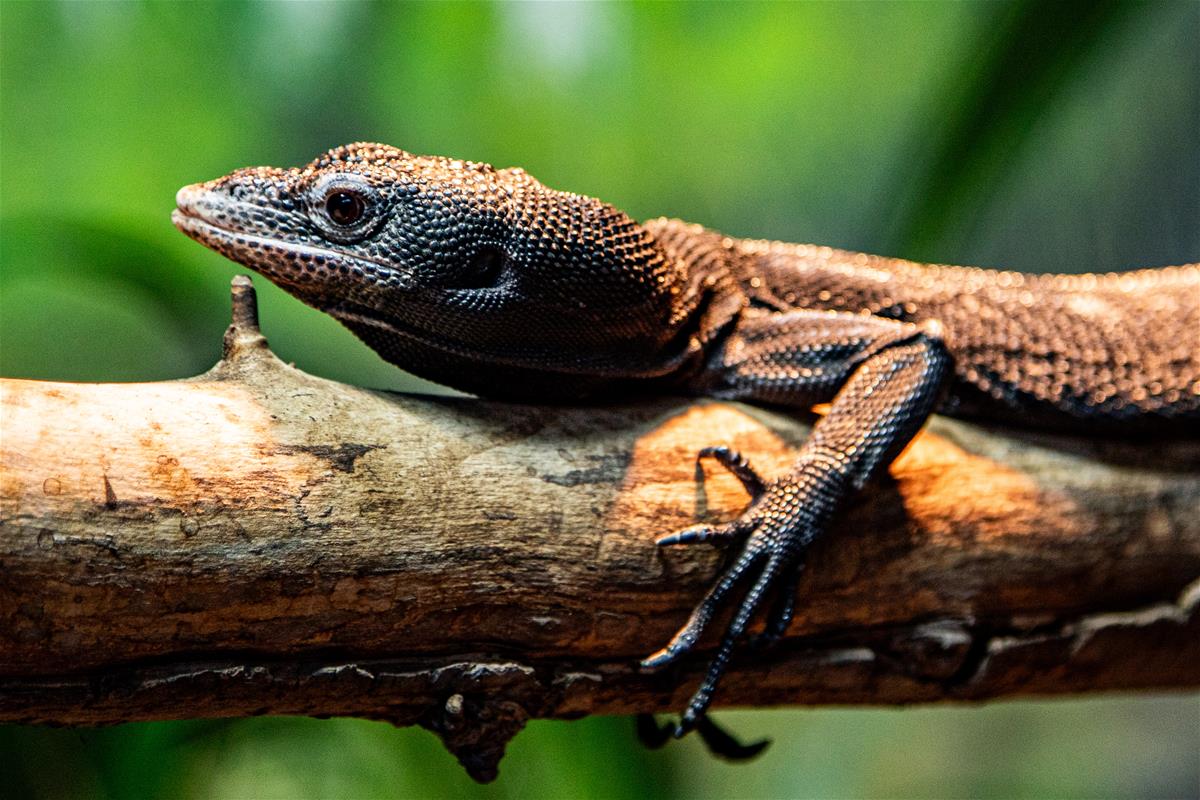
The Black Tree Monitor is a sleek, arboreal lizard notable for its uniform jet-black colouration, long limbs, and extremely slender body. Adults typically reach 90 to 120 centimetres in total length, with the tail making up more than half of that measurement. Its scales are smooth and glossy, giving the animal a polished appearance, while its long claws and flexible toes are well suited for gripping bark and branches.
Unlike many larger, ground-dwelling monitor lizards, this species is highly adapted to life in the forest canopy. It is agile, alert, and fast-moving, spending much of its time climbing and moving between trees. Its dark colouration provides effective camouflage in shaded forest environments. In zoological settings, the Black Tree Monitor is often featured as an example of arboreal specialization among reptiles and is known for its intelligence and active behaviour.
HEAD AND BODY LENGTH
Body length is typically 35–45 centimetres, with the total length reaching 90–120 centimetres including the tail.
WEIGHT
Adults usually weigh between 1 and 2 kilograms, depending on sex and condition.
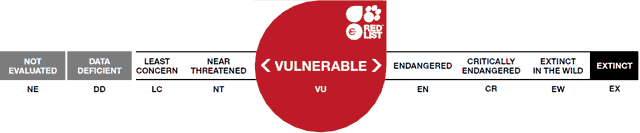
Conservation Status: IUCN
Distribution
Restricted to the Aru Islands of eastern Indonesia. Its limited range makes it particularly sensitive to environmental changes and habitat loss.
Habitat
Inhabits tropical lowland forests, especially areas with tall trees and complex canopy structure. It is almost entirely arboreal, rarely descending to the ground except to move between trees or lay eggs. Hollow trunks, dense foliage, and natural cavities provide shelter and nesting sites.
Diet
The Black Tree Monitor is carnivorous, feeding primarily on insects, spiders, small birds, eggs, reptiles, and occasionally small mammals. Its sharp teeth, keen eyesight, and quick reflexes make it an effective canopy predator. In captivity, it is typically fed a varied diet of insects and small vertebrate prey.
Reproduction
Females lay 2 to 6 eggs per clutch, often depositing them in tree hollows or decaying wood rather than underground. Incubation periods can be lengthy, lasting several months depending on environmental conditions. Hatchlings are independent at birth and quickly take to an arboreal lifestyle.
Adaptations
This species shows strong specialization for tree-dwelling life. Long claws and flexible digits provide excellent grip, while a long, whip-like tail aids balance. Its dark colouration reduces visibility in shaded forest interiors. High intelligence and curiosity-traits common to monitor lizards-support complex hunting behaviour and environmental awareness.
Threats to Survival
Primary threats include deforestation, loss of old-growth trees, and habitat fragmentation. Illegal collection for the pet trade has historically impacted populations, though improved regulation and captive breeding have reduced pressure. Climate change and small population size further increase vulnerability due to limited range and genetic isolation.