Viewable
Location at the Zoo
African Rainforest
Global Range
Africa
African Spoonbill
Platalea alba
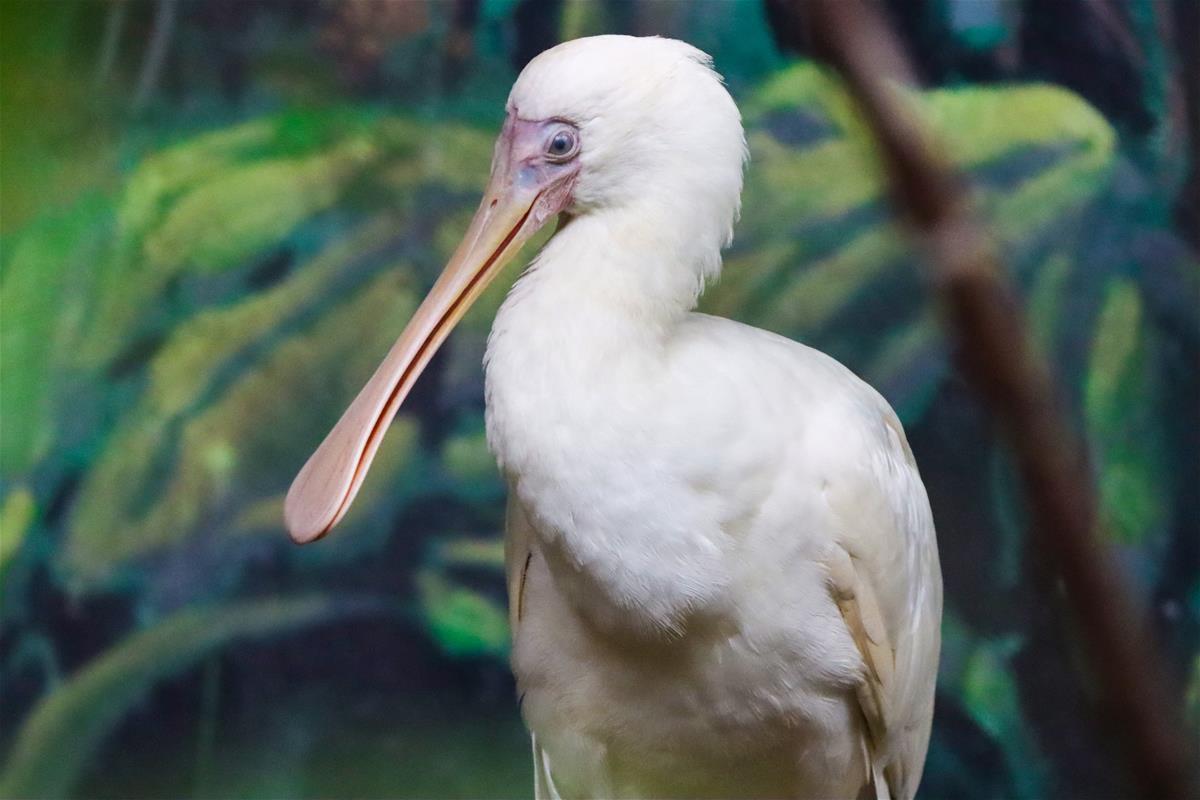
The African Spoonbill is a tall, elegant wading bird best recognized by its long, flattened bill that widens into a spoon-like shape at the tip. Adults typically stand about 80 to 90 centimetres tall, with a wingspan approaching 120 centimetres. The plumage is almost entirely white, contrasting with a reddish face, long dark legs, and a pale grey to yellowish bill. During the breeding season, adults develop a distinctive yellowish patch on the chest.
This species moves deliberately through shallow water, sweeping its bill side to side to detect prey by touch. Its graceful posture and unique feeding behaviour make it a striking presence in wetlands and a familiar sight in zoological aviaries.
HEAD AND BODY LENGTH
Approximately 75 to 90 centimetres from bill to tail.
WEIGHT
Generally between 1.2 and 1.8 kilograms.
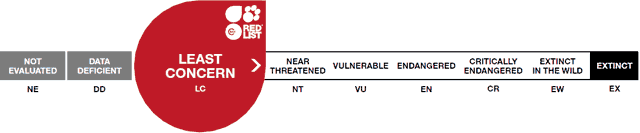
Conservation Status: IUCN
Distribution
Found throughout sub-Saharan Africa and on Madagascar, with occasional movements linked to seasonal rainfall and water levels. It is absent from arid desert interiors and dense forest regions.
Habitat
Inhabits shallow freshwater and coastal wetlands, including marshes, floodplains, lakeshores, estuaries, and sewage ponds. It favours areas with open, shallow water where prey can be detected by touch. During breeding, it nests in colonies, often alongside other waterbirds, in trees, reedbeds, or on low islands.
Diet
Feeds primarily on small fish, crustaceans, aquatic insects, frogs, and other invertebrates. Rather than relying on sight, the spoonbill sweeps its partially open bill through the water; when prey contacts the sensitive inner edges of the bill, it snaps shut reflexively. This tactile feeding strategy allows it to forage effectively in murky water.
Reproduction
Breeding typically follows seasonal rains that create suitable wetland conditions. Nests are built from sticks and reeds and placed in trees, shrubs, or reedbeds near water. Females usually lay 2 to 4 eggs, which are incubated by both parents. Chicks hatch helpless and are fed regurgitated food until they fledge several weeks later. Breeding success is closely tied to stable water levels and minimal disturbance.
Adaptations
The spoon-shaped bill is a highly specialized adaptation for tactile feeding in shallow water. Long legs allow the bird to wade efficiently while keeping the body dry. Its white plumage may help reflect heat in open wetlands, while strong wings support long-distance movements between feeding and breeding sites as water conditions change.
Threats to Survival
Primary threats include wetland loss, water pollution, and human disturbance at nesting sites. Climate change may also affect the timing and availability of suitable wetlands by altering rainfall patterns. Although the species remains widespread, the protection of wetland habitats is essential for its long-term stability.