Skip to content


Saving Frogs

Amphibian Ark

News Links


The Adopt-A-Pond Wetland Conservation Programme provides teachers, students and community groups with information resources and educational opportunities to conserve, restore and create wetland habitats.
How a Pond Comes to Life!

Click here to learn more about the frenzy of activity that happens in wetlands as winter turns to spring.

In Canada, in late March to early April, after the ice has finally slipped away, you will begin to hear the croaks of amphibians and the clammer of turtles as they emerge from a long winter. Ponds turn greener and come to life as aquatic plants spring into action. The trees around the pond begin to bud and various species of larva begin to develop.

In the spring, both frogs and turtles come out of hibernation and start to become more active, however not all species will come out of their winter hibernation fast. Some species will take their time, and begin to absorb sunlight first. During these months you may run into a turtle basking for long periods of time, this is because the waters are still cold and the turtles will often be seen out of the water absorbing the warmth from the sun and raising their body temperature.

Once the animals have shaken away the winter coldness they will start to eat more. Frogs generally eat worms and other small insects but they are also known to eat small fish. Turtles will eat small fish, worms, tadpoles, invertebrates, aquatic plants and even adult frogs!

The mating season of reptiles and amphibians typically starts in late spring. Some species of turtle have an elaborate and aggressive mating ritual, which often involve a mating dance. In early June these turtles will lay hard-shelled eggs in dug-out nests on a sandy beach, with hatchlings emerging at the end of the summer. During the frog mating season male frogs will make their way to a breeding pond where they will begin calling out for the females. In time, these frogs will find a suitable mate, with mating ending with the fertilization of hundreds of gelatinous eggs. As the warmer weather continues through the summer you will see the metamorphosis of these frog eggs from tadpole, to froglet, and eventually to frog.

Spring is a busy and exciting time around the pond, a great time to visit and the perfect time to tidy up your local wetland.


Dedicate a Day to Turtle Conservation! 

Turtles are remarkable and interesting creatures, with hundreds of species found all across the globe. Giants like the Galápagos Tortoise and the Leatherback Sea Turtle roam the planet, while tiny species like Ontario’s Stinkpot Turtle and Spotted Turtle like to stay close to home. But whatever your favourite species might be, every day presents a great opportunity to celebrate these ancient and remarkable reptiles. Are you a real turtle lover? Here are 10 simple things that you can do to help out them out.

  1. Join Ontario Turtle Tally and report your turtle sightings. Visit torontozoo.com/adoptapond/TurtleTally.asp to learn more or to make a submission.
  2. Sign out a book about turtles from your local library and learn a little more about these cool animals.
  3. Volunteer to take part in a wetland or shoreline clean-up. Visit shorelinecleanup.ca/ to sign-up for a clean-up in your neighbourhood.
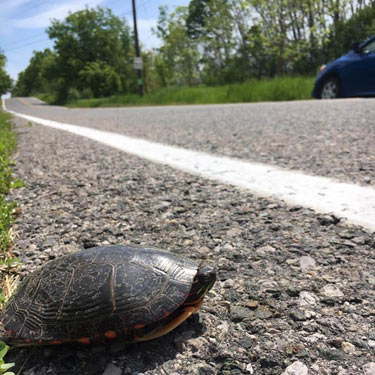
  4. Brake for turtles. If you see a turtle on the road, slow down, pull over and move the turtle across the road in the direction that it is heading.
  5. Don’t take turtles from the wild. The removal of turtle from the wild to keep them as pets has had devastating consequences for turtle populations.
  6. Get involved in building a wetland and help create habitat for turtles.
  7. Never release pet turtles.
  8. Raise money to buy a turtle crossing sign for a local road that you know turtles cross. Visit the turtle crossing sign section of the Adopt-A-Pond website at torontozoo.com/adoptapond/turtleCrossing.asp for more information.
  9. Never release balloons into the air. When they eventually come back down to the ground they create litter that can be mistaken by turtles for food.
  10. Teach a friend or family member about why turtles are important.


Where do frogs and turtles go in the winter?

Both frogs and turtles hibernate to protect themselves during the cold winter months. Hibernation is a state of inactivity and metabolic depression, characterized by lower body temperature and slower breathing. Read More....

In Canada, frogs and turtles begin to ready themselves for hibernation anytime from late September to late November (depending on fall temperatures). The habitat that these animals choose as an overwintering site varies according to species and climate conditions.

Typically, aquatic frogs (e.g. leopard frogs, bullfrogs, etc.) hibernate underwater in deep ponds, lakes and streams where they stay hidden behind logs and other debris to remain safe from predators. Terrestrial frogs (e.g. American toads, wood frogs, etc.) prefer to hibernate on land buried underneath leaf litter or wedged in the crevice of a log or a rock.

Most turtle species native to Ontario overwinter in deep ponds and stream banks where they either bury themselves into the mud or stay protected in sheltered areas. Some turtle species prefer to hibernate in slow-moving wetlands that freeze over entirely (e.g. painted turtle) whereas others prefer faster-moving waters (e.g. wood turtle). Occasionally, turtles even use muskrat burrows or beaver lodges as warm winter havens!

A common misconception is that frogs like to spend the winter the same way turtles do, buried in the mud at the bottom of a pond or stream. However, unlike turtles, hibernating frogs need a rich supply of oxygen to maintain physiological functions, so they often spend their time resting on top of the mud, or even swimming around occasionally if they are under water!

Most frogs and turtles will emerge again in late March to early April, just in time for mating to begin.


 Just Add Water

Just Add Water is a national campaign in the U.K. to encourage the public to dig wildlife ponds in urban areas. Visit the website here for a practical guide to building wetlands in your own backyard.

©2010 Toronto Zoo. All rights reserved. Images not to be reproduced.    Sitemap     admin

Turtle Island Conservation


Frog Watch Ontario
Ontario Turtle Tally
Wetland Guardians
Registry


Powered by